




Table of Contents
Important: This article is informational and does not constitute financial or legal advice.
Editorial Note:
The headline uses “block” for clarity and search relevance. More precisely, two US federal district judges vacated the Trump administration’s Public Service Loan Forgiveness regulation on 30 June 2026, one day before it was due to take effect.
The decisions concern employer eligibility within the Public Service Loan Forgiveness programme, commonly known as PSLF. They did not cancel every borrower’s debt, remove the programme’s standard eligibility conditions or change UK student-loan repayment rules.
Quick Answer: Why Did Federal Judges Block the Trump Loan Regulation?
Federal judges blocked the Trump loan regulation, finding the Department of Education lacked authority under the Higher Education Act to impose the new employer-disqualification test.
Judge Myong J. Joun ruled the measure was arbitrary, capricious and unconstitutional, while Judge Amir H. Ali found it exceeded statutory authority. Both vacated the rule before its 1 July 2026 start date.
As a result, the “substantial illegal purpose” test cannot take effect. PSLF remains in place, and standard eligibility rules still apply.
Key highlights:
- Two federal judges ruled that the Department of Education lacked authority under the Higher Education Act to introduce the new employer-disqualification test.
- The courts found the regulation unlawful, with one judge also determining it was arbitrary, capricious and in violation of the First Amendment.
- Both rulings vacated the regulation before its scheduled 1 July 2026 start date.
- The contested “substantial illegal purpose” test cannot be enforced as drafted.
- The Public Service Loan Forgiveness (PSLF) programme continues, but standard eligibility rules still apply.
What Trump Loan Regulation Did the Federal Judges Strike Down?
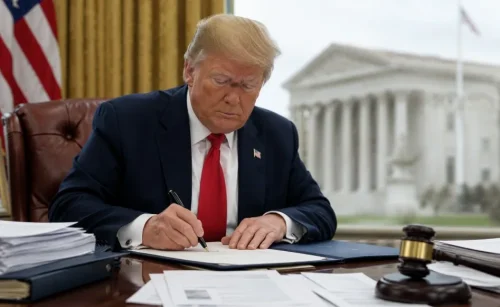
The dispute began after President Donald Trump issued an executive order in March 2025 directing the Department of Education to revise PSLF’s definition of public service. The administration argued that taxpayer-supported loan forgiveness should not benefit employees of organisations involved in certain illegal activities.
The resulting PSLF final rule published in the Federal Register would have allowed the education secretary to determine that an employer had a “substantial illegal purpose”. The listed areas included supporting terrorism, aiding or abetting immigration-law violations, illegal discrimination and patterns of violating state laws.
A disqualified organisation would no longer have counted as an eligible PSLF employer. Payments made by its employees after the department’s final determination would not have counted towards forgiveness, although previously recognised payments would generally have remained in place.
This distinction is important: the regulation targeted employers, but its financial consequences would have fallen directly on individual employees pursuing loan forgiveness.
How Would the Blocked PSLF Rule Have Affected Borrowers?
The proposed rule could have disrupted the connection between public-service employment, qualifying payments and eventual debt forgiveness.
How PSLF Normally Works?
PSLF is a federal programme for eligible borrowers with Direct Loans who work full-time for qualifying government or nonprofit employers. Borrowers generally need the equivalent of 120 qualifying monthly payments before requesting forgiveness of their remaining eligible balance.
Approval is not based on job title alone. Loan type, repayment arrangement, employer status, working hours, payment history and completed certification records can all affect the result.
Why Employer Eligibility Mattered?
Under the blocked rule, a borrower could have continued working in an otherwise lawful role yet stopped receiving PSLF credit because of a department-level determination about the employer.
That could have affected long-term decisions involving:
- Career planning and whether to remain in public service
- Expected loan-forgiveness dates
- Monthly household budgets
- Whether to change employers
- Recruitment into lower-paid public-interest roles
These consequences would not have been limited to employees personally accused of misconduct. The final rule acknowledged that some workers might lose future credit even when they had not participated in their employer’s alleged unlawful activity.
Organisations Facing Uncertainty
The legal challenges highlighted concerns among organisations involved in immigration assistance, civil-rights advocacy, healthcare, diversity initiatives and public-interest legal services.
Judge Joun concluded that the rule threatened lawful work and protected expression in areas that conflicted with the administration’s policy priorities. His judgment stated that the record showed the regulation had “already chilled protected speech”.
The key legal distinction was between proven unlawful conduct and lawful advocacy, representation, healthcare or policy work.
What Legal Reasons Led Both Judges to Reject the Regulation?

The two judges issued separate decisions, but both found a fundamental problem: Congress had defined the public-service employment covered by PSLF, and the Department of Education could not substantially rewrite those statutory choices through regulation.
Judge Ali held that the Higher Education Act requires PSLF to be available to borrowers working full-time for qualifying organisations, including eligible section 501(c)(3) nonprofits. He found that the secretary’s general rulemaking authority could not be used to alter the specific eligibility framework chosen by Congress.
Judge Joun reached several conclusions:
- The rule exceeded the department’s statutory authority.
- It relied on considerations Congress had not made relevant to PSLF.
- Important terms lacked sufficiently objective limits.
- The department had not established a rational connection between the rule and a demonstrated PSLF problem.
- The regulation discriminated according to viewpoint and violated the First Amendment.
In administrative law, “arbitrary and capricious” does not simply mean that a judge disagrees with a policy. It means that an agency failed to provide an adequate, lawful and evidence-based explanation for its action.
Judge Joun’s order stated: “The Final Rule is VACATED.”
Judge Ali also vacated the entire rule rather than limiting relief to the organisations that brought his case.
New York Attorney General Letitia James, who helped lead the multistate challenge, said: “Public servants should not have to pass a political loyalty test to earn the loan forgiveness they were promised.”
Her statement represented the challengers’ position rather than a neutral description of the judgments.
What Does the Ruling Mean for Borrowers and Existing PSLF Payments?
The rulings remove the challenged employer-disqualification framework, but they do not provide automatic loan forgiveness.
Is PSLF Still Available?
Yes. The courts struck down a new restriction within PSLF; they did not invalidate the programme itself.
Borrowers must still have eligible loans, qualifying employment and the required payment history. The official Federal Student Aid guidance on managing PSLF progress states that borrowers need 120 qualifying monthly payments and the required borrower and employer signatures.
What Happens to Existing Payment Counts?
The judgments do not erase recognised qualifying payments. They also do not automatically resolve individual account errors, disputed employment periods or questions about loan eligibility.
Borrower impact at a glance:
| Issue | Current position |
| PSLF programme | Continues to operate |
| Blocked employer test | Vacated by two district judges |
| Previously recognised payments | Not automatically removed by the judgments |
| Standard 120-payment requirement | Still applies |
| Automatic debt cancellation | Not created by these decisions |
| Future appeal or replacement rule | Remains possible |
Borrowers should therefore separate the broad legal victory from the administration of their individual accounts.
A practical example:
Consider a fictional immigration solicitor with US Direct Loans who works for a qualifying nonprofit and has 94 recognised PSLF payments.
Before the judgments, that employee might have worried that a department decision against the employer would prevent future payments from counting. After the rule was vacated, that particular restriction cannot take effect as drafted. The employee must still continue qualifying work, make required payments and maintain accurate certification records.
How Could the Decisions Affect Employers and the Public-Service Workforce?

PSLF is not only a borrower benefit. It can also support recruitment and retention in government, education, healthcare, social work, legal services and the nonprofit sector.
Workers with substantial student debt may accept lower public-service salaries partly because PSLF offers a defined route towards forgiveness after sustained qualifying employment. Regulatory uncertainty can weaken that incentive, particularly when employees cannot confidently predict whether future years of service will count.
Judge Joun’s opinion described the programme as a congressional effort to encourage people to enter and remain in public-service careers despite educational debt and comparatively modest earnings.
Employers should continue maintaining accurate payroll, employment and organisational records. They should also respond carefully to certification requests and avoid promising employees that forgiveness is guaranteed.
For organisations operating across multiple legal entities, correct employer identification numbers and employment dates remain particularly important.
What Should Borrowers Do Now to Protect Their PSLF Progress?
Borrowers do not need to panic or change employment solely because of the judgments. They should instead confirm that their individual records remain accurate.
Check Account and Employer Information
Borrowers should review their StudentAid.gov accounts and verify:
- Their federal loan type
- Current qualifying-payment count
- Employer eligibility information
- Certified employment dates
- Any period marked ineligible or requiring review
The rulings do not mean that every account will be updated automatically.
Should borrowers submit another PSLF form?
Not necessarily because of the judgments alone. However, submitting employment certification regularly may reveal errors before a borrower reaches 120 payments.
A review may be particularly useful after changing jobs, approaching forgiveness or finding an incorrect payment count. Borrowers should follow official instructions rather than repeatedly filing duplicate forms.
Keep independent records:
Borrowers should retain copies of:
- PSLF forms and employer signatures
- Payment histories and account statements
- Employment contracts or confirmation letters
- Servicer and Federal Student Aid correspondence
- Documents relating to disputed qualifying periods
Required payments should not be stopped because of a headline or social-media post. Anyone facing a disputed employer decision, serious servicing error or cross-border issue should consider obtaining advice from a qualified US student-loan or legal professional.
What Could Happen Next if the Trump Administration Appeals?
The judgments may not be the final stage of the dispute. The Department of Education said it was evaluating its next steps following the decisions.
Possible developments include an appeal, a request to stay the judgments during appellate proceedings, revised operational guidance or a narrower replacement regulation.
A stay would temporarily affect the practical force of a judgment while an appeal is considered. It would not itself determine whether the regulation is ultimately lawful.
Because the challenges were decided in different federal districts, any appeals could proceed through different appellate courts. That creates the possibility of separate schedules and legal reasoning, although both district judges vacated the same final rule.
Any replacement regulation would still need to comply with the Higher Education Act, the Administrative Procedure Act and constitutional protections. As of the last-checked date, borrowers should monitor official announcements rather than assume either that the litigation is over permanently or that the rule has already returned.
Why Does This US Loan Regulation Case Matter to UK Readers?

The decisions do not directly change the UK student-finance system, but they remain relevant to some UK-based borrowers and international employers.
US and UK Loans Follow Different Rules
PSLF applies to qualifying US federal Direct Loans and eligible public-service employment. UK student-loan repayments are instead governed by the borrower’s repayment plan and income.
Official GOV.UK student-loan repayment guidance explains that repayment obligations depend on the applicable UK plan. The US judgments do not alter Plan 1, Plan 2, Plan 4, Plan 5 or postgraduate-loan rules.
Which UK-based borrowers may be affected?
The case may still matter to:
- US citizens living in Britain
- Dual nationals with US federal student debt
- UK residents working for US-linked public-service organisations
- Employees considering a move between US and UK organisations
- International employers recruiting Americans pursuing PSLF
Working in the UK does not automatically establish or remove PSLF eligibility. The specific employer, employment arrangement and federal programme rules must be checked.
Wider Business Significance
The case also raises broader questions about regulatory certainty, agency authority and workforce planning.
Employees pursuing PSLF may structure ten years of career and financial decisions around a federal promise. Employers likewise rely on predictable rules when presenting public-service work as a viable long-term career.
Sudden changes to employer eligibility can therefore affect recruitment, retention and trust in government-administered programmes.
Conclusion
When federal judges blocked the Trump loan regulation, they prevented a new employer-disqualification test from taking effect within the Public Service Loan Forgiveness programme.
The decisions preserve the previous eligibility framework from that particular rule, but they do not guarantee forgiveness for every borrower. Standard loan, payment, repayment-plan and employment requirements continue to apply.
Borrowers should check their records, retain supporting documents and follow official updates. Employers should continue accurate certification and compliance processes. Further litigation or rulemaking remains possible, while ordinary UK student-loan arrangements remain unaffected.
Frequently Asked Questions
Did the court rulings automatically cancel anyone’s student debt?
No. The courts vacated a regulation governing employer eligibility. They did not order universal forgiveness or approve individual PSLF applications.
Were the decisions issued by the US Supreme Court?
No. Judge Myong J. Joun ruled in the US District Court for Massachusetts, and Judge Amir H. Ali ruled in the US District Court for the District of Columbia.
Does every government or nonprofit job qualify for PSLF?
No. Eligibility depends on the employer, employment arrangement, loan type, repayment conditions and qualifying-payment history.
How many qualifying payments are normally required?
Borrowers generally need 120 qualifying monthly payments while satisfying the programme’s employment and loan requirements.
Can borrowers stop making payments while litigation continues?
Borrowers should not stop making required payments solely because of the court decisions. Failure to follow repayment requirements may affect their accounts or PSLF progress.
Is this the graduate student borrowing-limit case?
No. That separate litigation concerned borrowing rules for graduate and professional study. The decisions covered here concern employer eligibility under PSLF.
Where can borrowers check their official PSLF status?
Borrowers can review their StudentAid.gov account, use the official PSLF tools and check authorised communications from Federal Student Aid or their loan servicer.
How We Checked This?
This article was checked against both federal district-court opinions, the Department of Education’s final rule, the Federal Register, Federal Student Aid guidance, official statements from the parties, Reuters reporting and current GOV.UK student-loan information.
The court opinions were reviewed separately to avoid presenting two independent judgments as one combined ruling. Claims about what the regulation would have done were compared with the final regulatory text rather than relying only on political statements or media summaries.