



Table of Contents
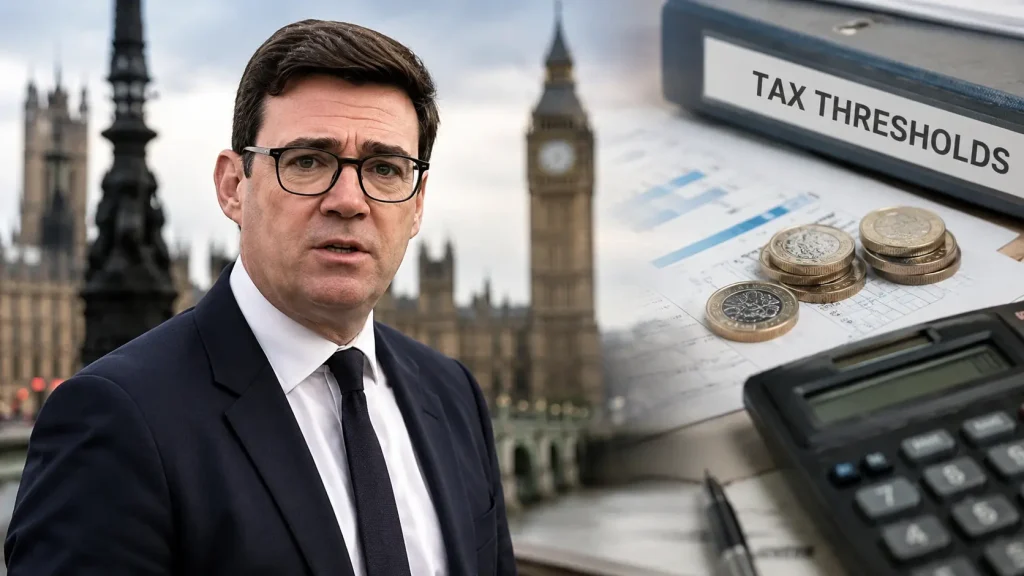
Prime Minister Andy Burnham has not announced an increase in the £12,570 Income Tax Personal Allowance. He has said there is currently no commitment to change it, although the proposal will be considered at the next Budget. This means an immediate tax-threshold increase has been put aside, rather than permanently ruled out.
Andy Burnham’s tax threshold comments have attracted attention because millions of UK taxpayers are affected by frozen Income Tax bands.
The issue concerns the Personal Allowance the amount most people can receive before they begin paying Income Tax. It is currently £12,570 and has remained at that level since April 2021.
Burnham raised expectations of a possible increase shortly before becoming Prime Minister. However, he has since clarified that the Government has made no commitment to change the allowance immediately and that any decision must be examined as part of the Budget process.
The distinction is important. There has been no confirmed Personal Allowance increase, but the possibility of a future change remains open.
What Is the Latest Andy Burnham Tax Threshold Update?
Andy Burnham has confirmed that increasing the Personal Allowance is not currently a Government commitment.
Speaking after reports that the proposal was not included in the Government’s initial cost-of-living programme, Burnham said:
“There is no commitment at this point to change, but we will look at that at the Budget.”
His comments followed earlier remarks in which he said frozen tax thresholds were frequently raised by voters during the Makerfield by-election campaign. He acknowledged that increasing the allowance would have significant consequences for Treasury revenue.
Therefore, the present position can be summarised as follows:
- The Personal Allowance remains £12,570.
- No immediate increase has been announced.
- The Government has not promised that the allowance will rise.
- The policy may still be examined at the next Budget.
- Any change would need to be costed and assessed against the Government’s fiscal rules.
The official GOV.UK ministerial profile confirms that Andy Burnham became Prime Minister on 20 July 2026 after returning to Parliament as the MP for Makerfield and becoming Labour leader.
Has Andy Burnham Permanently Ruled Out a Personal Allowance Increase?
No. Burnham has ruled out making an immediate commitment, but he has not permanently rejected an increase.
Some reports described the clarification as a reversal or retreat. A more precise interpretation is that Burnham initially identified frozen tax thresholds as an issue he wanted the Government to examine, without presenting a funded policy or giving a firm implementation date.
His later statement narrowed the position by confirming that there was no existing commitment. At the same time, he explicitly left the matter open for consideration at the Budget.
This distinction matters for taxpayers and businesses. A political expression of interest does not change tax law, payroll calculations or HMRC tax codes.
Until legislation or an official fiscal announcement is made, employers, pension providers and taxpayers must continue using the current thresholds.
What Is the UK Personal Allowance in 2026/27?
For the tax year running from 6 April 2026 to 5 April 2027, the standard Personal Allowance is £12,570.
According to the current Income Tax rates published by GOV.UK, the main bands for England, Wales and Northern Ireland are:
| Income band | Taxable income | Rate |
|---|---|---|
| Personal Allowance | Up to £12,570 | 0% |
| Basic rate | £12,571 to £50,270 | 20% |
| Higher rate | £50,271 to £125,140 | 40% |
| Additional rate | Above £125,140 | 45% |
The Personal Allowance begins to reduce when adjusted net income exceeds £100,000. It falls by £1 for every £2 earned above that amount and is normally removed entirely once income reaches £125,140.
These figures apply to a person receiving the standard allowance. Individual tax positions can differ because of pension contributions, taxable benefits, savings income, dividends, Marriage Allowance, expenses, tax-code adjustments and other circumstances.
Are Income Tax Thresholds Different in Scotland?

The £12,570 Personal Allowance applies across the UK, but Scotland sets its own rates and bands for Income Tax on most employment, pension and self-employment income.
For 2026/27, Scotland has separate starter, basic, intermediate, higher, advanced and top-rate bands. The Scottish Government’s official tax-band guidance should therefore be used when assessing the position of a Scottish taxpayer.
A UK Government decision to change the Personal Allowance would apply throughout the UK. However, the benefit received by a taxpayer could differ because Scottish rates and thresholds above the allowance are not the same as those in England, Wales and Northern Ireland.
Why Has the £12,570 Tax Threshold Become Controversial?
The threshold has become controversial because it has remained fixed while earnings, pensions and prices have increased.
When incomes rise but tax thresholds do not, a larger share of a person’s income becomes taxable. Some people also begin paying Income Tax for the first time, while others move from the basic rate into a higher band.
This process is known as fiscal drag.
The Office for Budget Responsibility describes fiscal drag as the increase in tax receipts that occurs when nominal incomes rise relative to frozen thresholds. It can increase an individual’s tax liability even when the Government does not raise the headline Income Tax rates.
For example, an employee may receive a pay rise that largely reflects inflation rather than a substantial improvement in living standards. If the Personal Allowance remains unchanged, more of the employee’s salary becomes subject to the 20% basic rate.
The same principle applies near the £50,270 higher-rate threshold. A salary increase can move part of a taxpayer’s income into the 40% band even though the tax rates themselves have not changed.
How Long Are UK Income Tax Thresholds Due to Remain Frozen?
Under the current policy, the Personal Allowance is due to remain at £12,570 until 5 April 2031.
The basic-rate limit is also being maintained at £37,700, which produces a higher-rate threshold of £50,270 for England, Wales and Northern Ireland.
The HMRC policy paper on maintaining tax thresholds says the freeze is intended to raise revenue for public services and support economic stability.
The extension covering 2028/29 to 2030/31 is forecast to raise approximately £12.4 billion in 2030/31 compared with allowing the relevant thresholds to increase with inflation.
HMRC also estimates that the extension will bring around 700,000 additional people into Income Tax by 2030/31 compared with CPI indexation from April 2028. These figures relate to the extension of the freeze, not the full revenue raised by every threshold freeze since 2021.
How Do Frozen Thresholds Affect Workers?

Frozen thresholds affect workers in several ways.
More Income Becomes Taxable
An employee receiving a pay rise keeps the same £12,570 tax-free allowance. The amount above it increases, creating a larger Income Tax bill.
More Employees Enter the Basic-rate Band
People whose annual taxable income rises above £12,570 may start paying Income Tax for the first time.
More Workers Become Higher-rate Taxpayers
Employees approaching £50,270 can begin paying 40% tax on part of their income after a pay rise, bonus or additional source of taxable income.
Savings Tax Allowances May Change
Moving into a different Income Tax band can also affect the Personal Savings Allowance. Basic-rate taxpayers can usually receive a larger amount of savings interest tax-free than higher-rate taxpayers.
The Business View’s guide to how much interest can be earned tax-free in the UK explains how the Personal Savings Allowance interacts with a person’s Income Tax band.
How Could Frozen Thresholds Affect Pensioners?
The Personal Allowance applies to taxable pension income as well as employment income.
The State Pension is taxable, although it is normally paid without tax being deducted directly. Private and workplace pensions are also generally taxable, with deductions commonly made through PAYE.
As pension income increases while the Personal Allowance remains frozen, more pensioners can become liable for Income Tax or see a greater share of their retirement income taxed.
The effect may be particularly important for someone who receives income from several sources, such as:
- the State Pension;
- a workplace pension;
- a private pension;
- part-time employment;
- savings interest; or
- rental income.
The Business View’s detailed guide on paying tax on a pension while still working explains how HMRC considers combined taxable income and allocates the Personal Allowance.
A pensioner does not receive an additional standard Personal Allowance simply because several pensions are being paid. The £12,570 standard allowance is normally applied to total taxable income.
How Much Could a £500 Personal Allowance Increase Save?
A £500 increase would not give every taxpayer £500 in cash.
For a basic-rate taxpayer, taking an additional £500 out of the 20% Income Tax band would normally reduce Income Tax by £100 a year.
A higher-rate taxpayer could potentially save £200 if the structure of the change also moved the higher-rate threshold upwards. The result would depend on how the Government designed the policy and whether it changed related limits.
The following examples are illustrative.
| Annual income | Income Tax under £12,570 allowance | Tax under hypothetical £13,070 allowance | Illustrative saving |
|---|---|---|---|
| £20,000 | £1,486 | £1,386 | £100 |
| £35,000 | £4,486 | £4,386 | £100 |
| £60,000 | £11,432 | £11,232 | £200 |
These calculations assume:
- a standard Personal Allowance;
- England, Wales or Northern Ireland rates;
- no taxable benefits or other adjustments;
- no dividend or savings income;
- no allowance taper above £100,000; and
- the £37,700 basic-rate limit remaining unchanged, causing the higher-rate threshold to rise with the allowance.
They do not include National Insurance. A real Government measure could produce different outcomes if the Personal Allowance, basic-rate limit and National Insurance thresholds were changed separately.
Why Is Raising the Personal Allowance Expensive?
A Personal Allowance increase applies widely. It can reduce the tax paid by millions of basic-rate and higher-rate taxpayers, including employees, pensioners and people receiving taxable investment or property income.
That broad reach makes the policy easy to understand, but also expensive for the Treasury.
Tax Policy Associates estimated that increasing the Personal Allowance by £500 could cost approximately £5 billion a year. The organisation also cautioned that the figure was an approximation based on HMRC’s June 2025 ready reckoner and that the scheduled update to the underlying HMRC estimates had been deferred. The estimate should therefore be treated as an indication of scale rather than a confirmed cost for a future Burnham policy.
This cost helps explain why the Prime Minister has avoided making an immediate promise.
Any threshold increase would need to be funded through some combination of:
- lower spending;
- higher taxation elsewhere;
- additional borrowing;
- stronger-than-expected revenue; or
- changes to another part of the tax system.
The Government has stated that further long-term cost-of-living decisions will be made at the Budget alongside an OBR forecast and must remain consistent with its fiscal rules.
Why Is the Government Waiting Until the Budget?
Tax-threshold decisions have significant consequences for public revenue, household incomes, payroll systems and the wider economy.
The Budget process allows the Chancellor and Treasury to assess the proposal alongside:
- updated economic forecasts;
- expected tax receipts;
- departmental spending;
- borrowing projections;
- inflation;
- employment conditions; and
- the Government’s fiscal rules.
John Healey, who became Chancellor of the Exchequer on 20 July 2026, is responsible for fiscal policy, taxation, public spending and presenting the Budget.
The Government has already chosen other immediate cost-of-living measures. Its first package included removing VAT from domestic electricity bills from 1 October 2026, with further longer-term measures reserved for the Budget and accompanying OBR forecast.
This suggests that the Government is separating measures it believes can be funded immediately from more expensive structural tax decisions requiring full fiscal assessment.
Could National Insurance Be Changed Instead?
Some tax specialists have argued that reducing employee National Insurance may be a more targeted way to support people in work.
The employee National Insurance primary threshold is currently aligned with the £12,570 Personal Allowance. However, the two thresholds do not have to remain identical.
A National Insurance reduction would mainly benefit people with earned income. Increasing the Personal Allowance would have a broader effect because it can also benefit people receiving taxable pensions, rent, savings or other non-employment income.
Tax Policy Associates argued that a cut to the main employee National Insurance rate could provide a larger benefit to many workers than spending a similar amount on a modest Personal Allowance increase. That is an expert policy recommendation, not an announced Government decision.
What Should Taxpayers Do Now?

No taxpayer needs to take action solely because of Burnham’s political comments.
The practical position remains unchanged:
- Continue using the current thresholds. The standard Personal Allowance remains £12,570 for 2026/27.
- Check the correct tax code. Employees and pension recipients should review their payslips, pension statements or HMRC Personal Tax Account.
- Consider all taxable income together. Salary, pensions, property income and some savings income can collectively affect the applicable tax band.
- Do not assume a Budget tax cut. The Government has made no commitment and has not confirmed the size, timing or design of any increase.
- Watch official sources. Any genuine change should be confirmed through HM Treasury, HMRC, GOV.UK and the Budget documentation.
- Review other recent tax changes separately. Employees examining their wider tax position may also find The Business View’s guide to the end of employee working-from-home tax relief in April 2026 useful.
Taxpayers should avoid making pension withdrawals, salary decisions or other financial commitments based solely on political speculation.
What Happens Next?
The next decisive stage will be the Budget.
The Treasury will need to determine whether increasing the Personal Allowance is affordable, whether another form of tax relief would provide better value and how any measure would interact with National Insurance and higher-rate thresholds.
Possible outcomes include:
- keeping the current freeze unchanged;
- increasing only the Personal Allowance;
- increasing both Income Tax and National Insurance thresholds;
- introducing a smaller targeted tax measure;
- changing tax rates instead of thresholds; or
- delaying reform until a later tax year.
At present, none of these options has been confirmed.
The clearest available conclusion is that Burnham has acknowledged public concern about frozen thresholds but has stopped short of promising a tax cut.
Key Takeaways
The Andy Burnham tax threshold update does not change the amount people can currently earn tax-free.
The standard Personal Allowance remains £12,570 for 2026/27 and, under existing policy, is due to stay frozen until April 2031.
Burnham has made no immediate commitment to increase it. However, he has said the proposal will be considered at the Budget, meaning a future change remains possible.
Frozen thresholds continue to create fiscal drag, bringing more income into tax as wages and pensions rise. An increase could reduce individual tax bills, but even a modest change would carry a multibillion-pound cost for the Treasury.
For now, taxpayers, employers and pension providers should continue applying the current rules and wait for a formal Budget announcement.
Frequently Asked Questions
Has Andy Burnham Increased the Tax Threshold?
No. The Personal Allowance remains £12,570, and no increase has been formally announced.
Has the Prime Minister Completely Ruled Out Changing the Personal Allowance?
No. He has said there is no current commitment, but the proposal will be examined at the Budget.
What is the UK Tax-free Allowance for 2026/27?
The standard Personal Allowance is £12,570 for the tax year from 6 April 2026 to 5 April 2027.
When Will the Personal Allowance Increase?
There is no confirmed increase date. Under current policy, the allowance is frozen at £12,570 until 5 April 2031, although a future Budget could change that position.
How Much Would a £500 Threshold Increase Save?
A basic-rate taxpayer would normally save around £100 a year in Income Tax. The precise amount would depend on income and how related thresholds were adjusted.
Does the £12,570 Allowance Apply in Scotland?
Yes. The UK-wide Personal Allowance is £12,570, but Scotland uses different Income Tax rates and bands above the allowance for most earned and pension income.
Do Pensioners Receive the Same Personal Allowance?
Most pensioners receive the same standard £12,570 Personal Allowance. Taxable pension income is counted when determining whether the allowance has been exceeded.
Will an Announcement Automatically Change a Person’s Tax Code?
No. HMRC and payroll providers will update tax codes only after a formal policy change has been confirmed and implemented.
What is Fiscal Drag?
Fiscal drag occurs when incomes rise while tax thresholds remain fixed. It causes more income to be taxed and can move people into higher tax bands without an increase in headline tax rates.
