



Table of Contents
UK airport liquid rule changes have made preparing hand luggage more convenient at some terminals but more confusing across the country. In 2026, passengers departing from Heathrow, Gatwick and several other airports can take liquids through security in containers holding up to two litres. Other airports, including Manchester, Stansted and Luton, continue to apply a 100ml container limit.
The important point is that new security scanners do not automatically mean larger liquid containers are permitted. Some airports allow passengers to leave liquids and electronic devices inside their cabin bags while still enforcing the 100ml limit.
According to the current GOV.UK hand-luggage guidance, passengers must check the rules for the particular airport they are departing from. Return and connecting airports may apply different limits.
What Are the UK Airport Liquid Rules in 2026?
There is no single liquid rule across every UK airport in 2026.
Some airports allow individual containers holding up to two litres. Others continue to limit individual containers to 100ml, even when the container is only partly full. The requirement to use a clear plastic liquids bag also varies.
The safest approach is to follow the most restrictive rule applying anywhere on the itinerary. When the return or connecting-airport rules cannot be confirmed, passengers should use containers of 100ml or less or pack larger toiletries in checked baggage.
What Changed With UK Airport Liquid Rules?
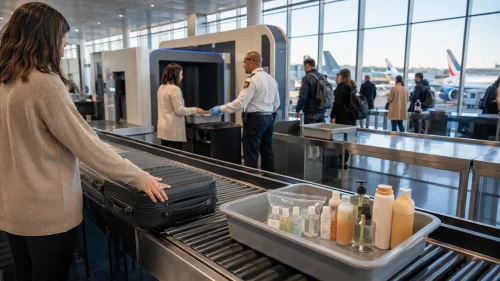
The UK has been introducing next-generation computed tomography, or CT, scanners at airport security checkpoints. These scanners create more detailed images of cabin-bag contents than traditional X-ray equipment.
At airports where the technology and relevant operating approvals permit it, passengers may be able to:
- Leave liquids inside their cabin baggage
- Leave laptops and tablets inside the bag
- Carry liquids in containers holding up to two litres
- Pass through security without a separate transparent liquids bag
However, these changes are not necessarily introduced together. An airport may permit liquids to stay inside the bag but continue to restrict each container to 100ml.
This distinction explains why passengers should not assume that the presence of new scanners means the two-litre rule applies.
What is the Traditional 100ML Liquid Rule?
At an airport using the 100ml limit, every standard liquid container in hand luggage must hold no more than 100ml.
The capacity of the container matters not the amount remaining inside it. A 200ml bottle containing only 50ml of shampoo may therefore be rejected because the bottle itself exceeds the permitted capacity.
GOV.UK also says that airports may require qualifying containers to be placed in a single transparent, resealable bag with a maximum capacity of one litre. Where this procedure applies, the bag should measure approximately 20cm by 20cm, close fully and be presented separately at security. Not every airport still requires this bag. (GOV.UK)
What Does the Two-litre Airport Rule Mean?
At an airport operating the two-litre rule, an individual liquid container may generally hold up to two litres.
The rule does not mean that passengers are automatically entitled to carry any quantity or type of liquid. Cabin-bag size and weight limits still apply, and certain products particularly aerosols, flammable substances and dangerous goods are governed by separate aviation-safety restrictions.
Some two-litre airports permit multiple containers, provided each container stays within the airport’s maximum size. Birmingham, Bristol and Edinburgh explicitly state that passengers may carry more than one qualifying container, although the contents must still fit within the traveller’s permitted hand baggage. (Birmingham Airport)
Which UK Airports Use the 100ML or Two-litre Rule in 2026?
The following comparison covers major and commonly searched UK airports. It is not intended as a permanent or exhaustive list because airport procedures can change.
| UK airport | Current standard container limit | Liquids during screening | Separate clear bag? | Important qualification |
|---|---|---|---|---|
| London Heathrow | Up to 2 litres | Stay inside cabin bag | Not required | Metal and insulated bottles must be empty |
| London Gatwick | Up to 2 litres | Stay inside cabin bag | Not required | Metal and double-walled containers must be empty |
| Birmingham | Up to 2 litres | Stay inside cabin bag | Not required | Insulated bottles must be empty |
| Bristol | Up to 2 litres | Stay inside cabin bag | Not required | Metal drinks bottles must be empty |
| Edinburgh | Up to 2 litres | Stay inside cabin bag | Not required | Metallic and double-walled containers must be empty |
| London Southend | Up to 2 litres | Stay inside cabin bag | Not required | Metal containers and flasks must be empty |
| Belfast International | Up to 2 litres | Stay inside cabin bag | Not required | Items may receive additional screening |
| Belfast City | Up to 2 litres | Stay inside cabin bag | Not required | Check other airports used on the journey |
| Manchester | 100ml | Stay inside cabin bag | Not required | Containers over 100ml are not accepted even if partly full |
| London Stansted | 100ml | Stay inside cabin bag | Not required | New scanners have not removed the 100ml limit |
| London Luton | 100ml or 100g | Stay inside cabin bag | Not required | Creams, pastes, lotions and gels are included |
| London City | 100ml | Stay inside cabin bag | Check current guidance | Its current page instructs passengers to use containers of 100ml or less |
| Teesside International | 100ml | Stay inside cabin bag | Not required | Current instructions supersede older reports about a two-litre allowance |
| Newcastle International | 100ml | Stay inside cabin bag | Not required | Empty metal containers are permitted; liquids inside them are not |
| Liverpool John Lennon | 100ml | Stay inside cabin bag | Not normally required | Maximum applies per container |
| Glasgow | 100ml | Stay inside cabin bag | Not required | Airport-purchased liquids may require a tamper-evident bag |
The two-litre airport entries are based on current guidance published by Heathrow, Gatwick, Birmingham, Bristol, Edinburgh, Southend, Belfast International and Belfast City. (Heathrow Airport)
The 100ml entries are supported by current operational guidance from Manchester, Stansted, Luton, London City, Teesside, Newcastle, Liverpool and Glasgow. (Manchester Airport)
Why Passengers Should Be Careful With Older Airport Lists?
Some online reports remain visible long after airport instructions have changed.
Teesside provides a useful example. An older Teesside announcement about removing the 100ml restriction described a two-litre allowance. However, the airport’s current hand and hold baggage guidance instructs departing passengers to use containers of up to 100ml.
For practical travel decisions, the current airport security or baggage page should take priority over an older announcement or third-party article.
Does a New Security Scanner Mean the 100ML Rule Has Ended?
No. New scanners and larger liquid allowances are related, but they are not the same rule.
Manchester Airport’s guidance, last updated in April 2026, allows liquids and electronic items to remain inside hand luggage but continues to prohibit standard liquid containers over 100ml. Stansted and Luton operate similar procedures.
Passengers therefore need to check two separate questions:
- Can liquids stay inside the hand luggage during screening?
- What is the maximum permitted capacity of each container?
An airport may answer “yes” to the first question while still setting a 100ml limit for the second.
What Counts as a Liquid at UK Airport Security?
Airport liquid rules cover more than water and other drinks. Products that can be poured, sprayed, spread or squeezed will commonly be treated as liquids, gels or aerosols.
Examples include:
- Water, juice and other drinks
- Soup, sauces, syrups and oils
- Jam, honey and preserves
- Toothpaste
- Shampoo and shower gel
- Sun cream and moisturiser
- Perfume and aftershave
- Mascara and lip gloss
- Hair gel
- Shaving foam
- Deodorant sprays
- Contact-lens solution
- Soft cheese and other spreadable foods
- Liquid-solid mixtures
Gatwick’s security guidance, for example, treats food, cosmetics and toiletries that can be poured, spread or squeezed as liquids. Frozen liquids are also treated as liquids there, while Edinburgh states that frozen liquids and foodstuffs are not permitted in cabin baggage. (London Gatwick Airport)
Is the Two-litre Allowance Per Container or in Total?
At airports such as Heathrow, Birmingham, Bristol and Edinburgh, the published limit applies to the capacity of each individual container.
Birmingham states that there is no airport-security limit on the number of qualifying two-litre containers. Edinburgh also permits multiple containers of up to two litres. Bristol warns that everything must still fit within the passenger’s airline hand-baggage allowance.
That distinction matters. Airport security may allow several bottles, but the airline may still restrict:
- The dimensions of the cabin bag
- The total cabin-bag weight
- The number of bags
- Certain substances or dangerous goods
- Items carried on particular routes
A two-litre airport rule should not be interpreted as an unlimited cabin-baggage entitlement.
Do Metal Water Bottles and Vacuum Flasks Have to Be Empty?
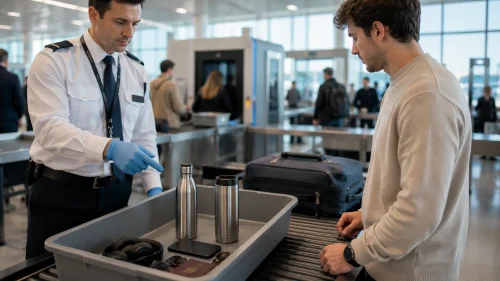
Many airports operating the two-litre rule still require metal, insulated or double-walled containers to be empty.
This applies at Heathrow, Gatwick, Birmingham, Bristol, Edinburgh and Southend. Passengers may usually refill an empty bottle after clearing security.
The restriction exists because the construction of certain containers can make effective screening more difficult. A passenger carrying an ordinary plastic bottle may therefore be permitted to keep the liquid inside, while a traveller carrying the same amount in a vacuum flask may be required to empty it.
Are Aerosols Covered by the Two-litre Rule?
Aerosols can be subject to stricter dangerous-goods limits than ordinary liquids.
The UK Civil Aviation Authority’s baggage safety guidance states that permitted toiletry and medicinal aerosols generally must not exceed 0.5 litres or 0.5kg per article, with an overall maximum of two litres or 2kg per person. Release valves must also be protected against accidental discharge.
Southend similarly warns that aerosols larger than 500ml are not permitted, despite its general two-litre liquid allowance. (London Southend Airport)
Passengers carrying large aerosols should check both the airport’s security instructions and the airline’s dangerous-goods policy.
Do Liquids Still Need to Go in a Clear Plastic Bag?
That depends on the airport.
Several airports retaining the 100ml container limit including Manchester, Stansted, Luton, Newcastle and Glasgow now allow liquids to remain inside hand luggage without being placed in a separate transparent bag.
Other airports may still use the traditional process. GOV.UK therefore says that passengers “may” have to use a separate transparent bag rather than describing the bag as a universal requirement.
Even when a clear bag is not compulsory, using a leak-resistant toiletries pouch can remain useful because it:
- Protects clothing and electronic devices from spills
- Keeps products together if additional screening is required
- Makes it easier to comply with a different return airport
- Helps passengers move products into a clear bag if instructed
Which Rules Apply on Connecting and Return Flights?
The security checkpoint being used at that stage of the journey determines the liquid-screening rule.
A passenger departing from Heathrow may be permitted to carry a 500ml bottle through security. If the return airport applies a 100ml limit, that same bottle may not be accepted on the journey home.
Connecting passengers can also face another security check. Whether re-screening is required depends on the airport, route, terminal transfer and local arrangements.
The most reliable packing principle is therefore:
Passengers should pack according to the strictest airport security rule applying anywhere on the complete itinerary.
That means checking:
- The UK departure airport
- Every connecting airport
- The airport used for the return flight
- Any airport where passengers must collect and recheck baggage
- Relevant airline hand-baggage and dangerous-goods rules
Heathrow, Edinburgh, Birmingham, Bristol and Southend all advise travellers to check other airports used during outward, connecting or return travel because procedures are not uniform. (Heathrow Airport)
Are Medicines Exempt From the Normal Liquid Limit?
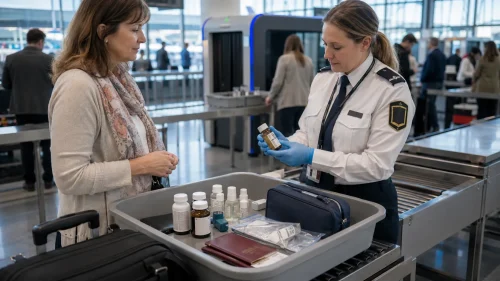
Essential liquid medicines, special dietary liquids and certain medical products may be taken through security in larger containers.
Under GOV.UK’s liquid exemptions, containers of up to two litres may be taken through all UK airports when they are required for essential medical purposes or special dietary needs. Security staff may inspect or test them.
Passengers may need:
- A prescription bearing the traveller’s name
- A doctor’s or medical professional’s letter
- The original labelled packaging
- Evidence explaining why the liquid is required
The Civil Aviation Authority advises passengers carrying more than 100ml of liquid medicine to have a prescription or supporting medical letter. Travellers carrying a large quantity should contact the airport in advance.
What Are the Rules for Baby Milk, Baby Food and Sterilised Water?
Passengers travelling with a baby may carry baby milk, baby food and sterilised water needed for the journey.
The products can be screened separately, and airport staff may need to open a container. Airports may also apply limits to the size of individual containers, so the relevant departure airport should still be checked.
GOV.UK recognises baby milk and baby food as exemptions from the ordinary liquid limit. (GOV.UK)
Can Duty-free Liquids Exceed 100ML?
Liquids bought after security or during a flight may be permitted in containers larger than the airport’s normal limit, including when a passenger transfers through another security checkpoint.
GOV.UK says the items should be:
- Sealed inside the security bag provided at purchase
- Accompanied by a visible receipt sealed inside the bag
- Kept unopened until the final destination
Security officers may still open the bag when additional screening is necessary.
Passengers should not open or transfer duty-free liquids before completing a connecting journey.
Real-life Example: Heathrow Departure and Stansted Return
Consider a passenger flying from Heathrow and returning to Stansted.
At Heathrow, a 500ml plastic bottle of shampoo may be accepted because the airport allows liquids in containers of up to two litres. The bottle can remain inside the cabin bag.
On the return journey, the overseas departure airport’s rules apply not Heathrow’s rules. If the passenger later departs again from Stansted, the same 500ml bottle will not meet Stansted’s 100ml container limit, even though Stansted allows smaller liquids to remain inside the bag.
The passenger has several practical options:
- Use bottles of 100ml or less throughout the trip
- Put larger toiletries in checked baggage
- Buy toiletries after arrival and use them before returning
- Decant products into properly labelled compliant containers
- Verify the return airport before packing
This example shows why a relaxed outbound rule should not determine how the whole journey is packed.
Common Misinformation About UK Airport Liquid Rule Changes
“the 100ML Rule Has Been Abolished Throughout the UK”
This is incorrect. Several airports still enforce the 100ml container limit.
“New Scanners Mean Passengers Can Carry Two-litre Bottles”
Not necessarily. Manchester, Stansted, Luton, London City, Newcastle and other airports use procedures that allow liquids to remain inside bags while retaining the 100ml limit.
“a Half-full 200ML Bottle is Allowed at a 100ML Airport”
It is not normally allowed. The container’s maximum capacity not the amount remaining determines whether it meets the limit.
“Airlines Decide the Airport Liquid Rule”
Airport security arrangements determine what passes through the checkpoint. Airlines separately control cabin-bag size, weight and dangerous-goods acceptance.
“the Outward and Return Rules Will Be the Same”
They may be completely different. Each airport applies its own current security process.
How Should Passengers Check an Airport’s Current Rule?
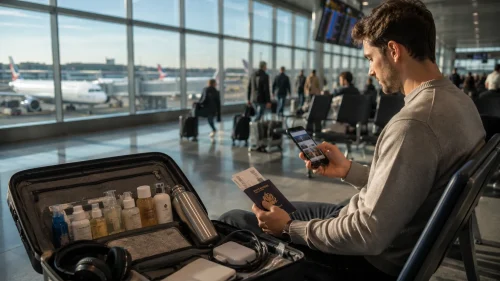
Passengers should use the following process shortly before departure:
- Open the airport’s official website rather than relying solely on a search-result summary.
- Find the current security, hand-baggage or liquid-restrictions page.
- Check the maximum capacity of each container.
- Confirm whether liquids stay inside the bag.
- Check whether a transparent bag is required.
- Look for separate instructions covering metal bottles, aerosols and frozen products.
- Repeat the process for every connection and the return airport.
- Check the airline’s cabin-bag and dangerous-goods rules.
Older news articles should be treated cautiously, particularly when a current operational page gives different instructions.
Passengers arranging wider international travel documents may also find Business IN Canada’s guides to renewing a UK passport while living in Canada and applying for a Schengen visa from Canada useful. These are individual blog resources rather than category pages.
Pre-flight Liquids Checklist
Before leaving for the airport, travellers should confirm that:
- Every airport on the itinerary has been checked
- Containers comply with the strictest applicable limit
- Larger toiletries are packed in checked baggage where necessary
- Metal and insulated bottles are empty
- Medicines are accompanied by supporting evidence
- Baby products are limited to reasonable journey needs
- Duty-free security bags remain sealed
- Aerosols meet separate aviation-safety limits
- Cabin baggage remains within the airline’s size and weight allowance
- The guidance has been checked again close to departure
Key Takeaways
- UK airport liquid rules are not uniform in 2026.
- Heathrow, Gatwick, Birmingham, Bristol, Edinburgh and several other airports permit containers of up to two litres.
- Manchester, Stansted, Luton and a number of other airports continue to use the 100ml limit.
- New scanners may let liquids remain inside a bag without increasing the permitted container size.
- The capacity printed on the container matters, even when the container is partly empty.
- Metal, insulated and double-walled bottles may need to be empty.
- Aerosols can be subject to separate limits.
- Connecting and return airports must be checked independently.
- Following the strictest rule on the complete itinerary is the safest packing approach.
Conclusion
The UK airport liquid rule changes have created a mixed system of 100ml and two-litre limits for 2026. The experience at security now depends on the airport, its approved equipment and its current operating instructions.
Passengers should not rely on the general claim that the 100ml rule has been abolished. Nor should they assume that being allowed to leave liquids inside hand luggage means full-size containers are accepted.
Checking the official departure, connecting and return-airport pages remains the most reliable way to avoid delays, disposal of belongings or repacking at security.
Frequently Asked Questions
Has the 100ML Liquid Rule Been Scrapped at All UK Airports?
No. Some airports permit containers of up to two litres, but others continue to limit standard liquid containers to 100ml.
Which Major UK Airports Allow Two-litre Liquid Containers in 2026?
Current official guidance confirms a two-litre limit at Heathrow, Gatwick, Birmingham, Bristol, Edinburgh, Southend, Belfast International and Belfast City. Airport guidance should be rechecked before travel.
Can Passengers Take a 500ML Bottle Through Heathrow Security?
Yes, Heathrow allows ordinary liquid containers holding up to two litres. Reusable metal and insulated bottles must be empty during screening.
Does Manchester Airport Still Use the 100ML Rule?
Yes. Manchester allows qualifying liquids to remain inside hand luggage, but each standard container must stay within the 100ml limit.
Does Stansted Allow Liquids to Remain Inside Hand Luggage?
Yes. Liquids can remain inside the bag, but Stansted still restricts each standard container to 100ml.
Does Luton Airport Have a Two-litre Liquid Allowance?
No. London Luton’s current guidance limits liquids, creams, pastes, lotions and gels to containers of up to 100ml or 100g.
Can a 200ML Bottle Pass Security if It is Almost Empty?
Not at an airport using the 100ml rule. The bottle’s total capacity determines compliance, rather than the quantity remaining inside.
Can Passengers Carry More Than One Two-litre Container?
Some airports, including Birmingham, Bristol and Edinburgh, permit multiple qualifying containers. Everything must still comply with airline cabin-bag and dangerous-goods restrictions.
Do Reusable Water Bottles Need to Be Empty?
Plastic bottles may be allowed to contain liquid at a two-litre airport, but metal, insulated and double-walled bottles often have to be empty. The airport’s specific guidance should be checked.
Are Medicines Allowed in Containers Larger Than 100ML?
Essential liquid medicines and special dietary liquids may qualify for an exemption. Passengers should carry a prescription, labelled packaging or a medical letter where required.
Do the UK Liquid Rules Apply to the Return Flight?
Only when the passenger departs from a UK airport. A return flight from another country follows the rules of the overseas departure airport and any connecting security checkpoints.