




Table of Contents
Last checked against official guidance: 26 June 2026
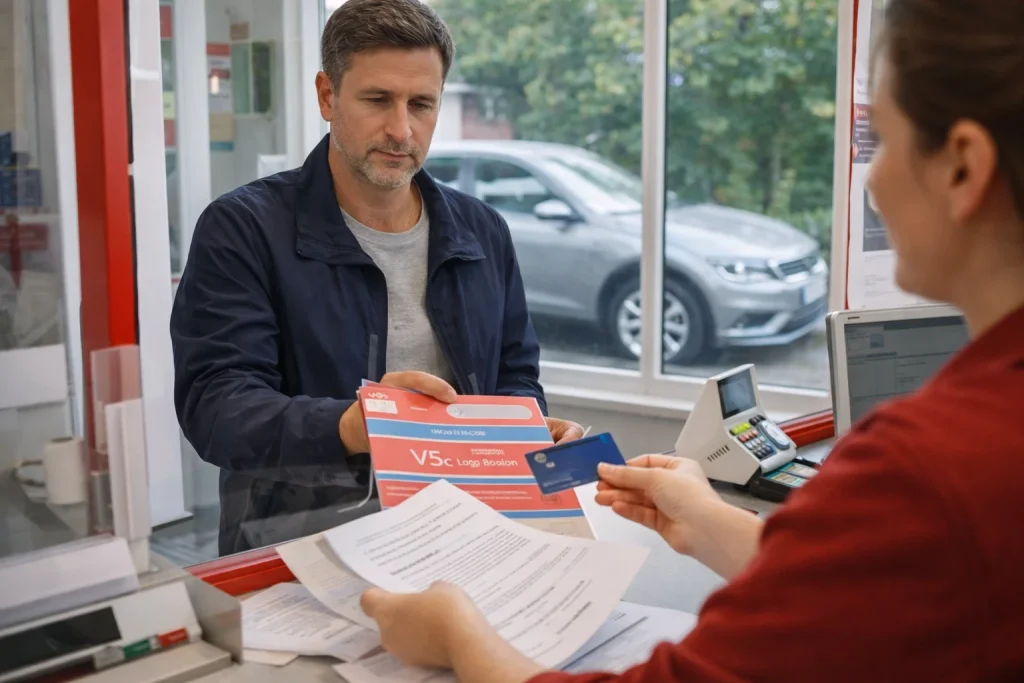
To change a vehicle tax class from disabled to normal, you usually need to visit a Post Office branch that deals with vehicle tax. This is because changing a car tax class to or from “disabled” normally requires documents to be checked before the vehicle can be taxed in the correct class.
You will usually need your V5C log book, a valid MOT if the vehicle needs one, and payment for the correct Vehicle Excise Duty rate. If you have recently bought a car that was previously taxed in the disabled class, you must tax it correctly before using it on the road because vehicle tax does not transfer to the new keeper.
Before you start, check:
- Whether the vehicle is already taxed or has been sold with disabled tax
- Whether you have the V5C log book or the green new keeper slip
- Whether the vehicle needs a valid MOT
- The correct tax rate for your vehicle
- Whether your local Post Office branch offers vehicle tax services
Changing the tax class quickly is important because a vehicle that remains in the disabled tax class when it is no longer eligible may be treated as incorrectly taxed or untaxed.
What Is a Disabled Vehicle Tax Class?
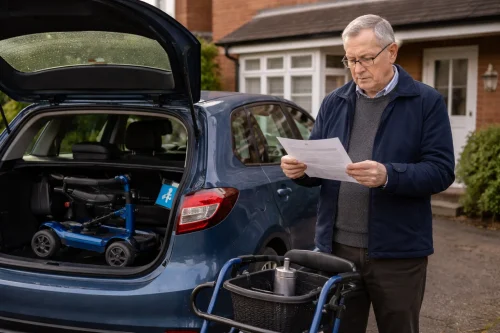
A disabled vehicle tax class is a vehicle tax category that allows eligible disabled people, or their nominated drivers, to pay no vehicle tax or a reduced rate on one qualifying vehicle.
The exemption is normally linked to certain mobility benefits, such as the higher rate mobility component of Disability Living Allowance, the enhanced mobility component of Personal Independence Payment, Adult Disability Payment, War Pensioners’ Mobility Supplement, or Armed Forces Independence Payment.
The vehicle must be used for the disabled person’s personal needs. It should not be used by a nominated driver for their own personal journeys unless the journey benefits the disabled person.
Once the vehicle is no longer used in this way, or the disabled person is no longer eligible, the vehicle should be taxed in the correct normal tax class.
Why Would You Need to Change Vehicle Tax Class From Disabled to Normal?
You may need to change vehicle tax class from disabled to normal if the vehicle is no longer eligible for the disabled tax exemption.
Common reasons include:
- You bought a used car that was previously taxed by a disabled keeper
- The registered keeper has changed
- The disabled person no longer qualifies for the exemption
- The vehicle is no longer mainly used for the disabled person’s benefit
- The vehicle is being used as a normal private car
- The vehicle needs to move back to a standard tax class such as Private/Light Goods
The most common situation is buying a second-hand car that still shows disabled tax. The exemption does not stay with the car for the benefit of the new owner. The new keeper must tax the vehicle in their own name before driving it.
Can You Change Vehicle Tax Class From Disabled to Normal Online?
No, not usually. Although many vehicle tax tasks can be completed online, changing a car tax class to or from disabled normally requires a Post Office branch that deals with vehicle tax.
You can still use GOV.UK to:
- Check whether the vehicle is taxed
- Check MOT status
- Find current vehicle tax rates
- Confirm which documents are needed
- Check whether a vehicle is registered as SORN
However, the actual change from disabled to normal tax class is usually handled through a Post Office vehicle tax branch, because the documents need to be checked.
How to Change Vehicle Tax Class From Disabled to Normal at a Post Office?
The usual method is to visit a Post Office branch that deals with vehicle tax.
Take the required documents with you and explain that you need to change the vehicle tax class from disabled to normal. The Post Office can check the documents, calculate the correct tax, and tax the vehicle in the appropriate class.
You will usually need:
- V5C registration certificate, also called the log book
- V11 reminder letter, if you have received one
- Valid MOT evidence, if the vehicle needs an MOT
- V112 form, if the vehicle is MOT exempt
- Payment for the correct vehicle tax
- V62 form if you do not have the V5C
- Green V5C/2 new keeper slip if you have recently bought the vehicle
If the application is accepted, the vehicle tax class can be updated and the vehicle can be taxed correctly.
What Documents Do You Need?
| Document | Why It Is Needed | When It Is Needed |
| V5C log book | Confirms vehicle details and registered keeper information | Usually required |
| V11 reminder | Helps renew or change tax when tax is due | If received |
| MOT certificate or MOT history | Shows the vehicle has a valid MOT | If the vehicle needs MOT |
| V112 form | Declares MOT exemption | If the vehicle is MOT exempt |
| V62 form | Applies for a replacement V5C | If the log book is missing |
| Green V5C/2 slip | Allows a new keeper to tax the vehicle | If recently purchased |
| Payment | Covers the new vehicle tax rate | When moving to normal tax |
If the vehicle is registered in Northern Ireland, you may also need an insurance certificate or cover note valid when the tax starts.
What If You Bought a Car With Disabled Tax?
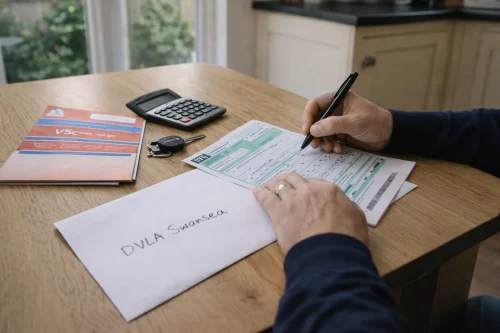
If you bought a car with disabled tax, do not assume the tax transfers to you. Vehicle tax is cancelled when DVLA is told the vehicle has been sold or transferred, and the new keeper must tax the vehicle before using it on the road.
You should:
- Check the V5C or green new keeper slip.
- Visit a Post Office branch that deals with vehicle tax.
- Ask to change the tax class from disabled to normal.
- Provide MOT evidence if needed.
- Pay the correct vehicle tax.
- Keep proof that the vehicle has been taxed.
You should not drive the vehicle until it is taxed correctly in your name, unless you are personally eligible for the disabled tax class and have completed the correct process.
What If You Do Not Have the V5C Log Book?
If you do not have the V5C log book, you may need to complete form V62 to apply for a replacement registration certificate.
If you have just bought the vehicle and have the green new keeper slip from the most recent V5C, the replacement V5C may be free. If you do not have the correct green new keeper slip, there is normally a £25 fee.
In some cases, you may be able to tax the vehicle at the Post Office while applying for a replacement V5C, but you should check that the branch offers vehicle tax services before travelling.
How Much Does It Cost to Change From Disabled Tax to Normal Tax?
There is no separate “change fee” for simply changing the tax class, but you will usually need to pay the correct vehicle tax for the new normal tax class.
The amount depends on:
- Vehicle registration date
- CO2 emissions
- Fuel type
- Engine size for older vehicles
- Whether the vehicle is electric, petrol, diesel, hybrid or alternative fuel
- Whether the expensive car supplement applies
For cars registered on or after 1 April 2017, the standard annual rate from April 2026 is £200 for the second tax payment onwards. Some vehicles may cost more, especially where the expensive car supplement applies.
Older vehicles are taxed differently. Cars registered between 1 March 2001 and 31 March 2017 are usually taxed by CO2 emissions. Cars registered before 1 March 2001 are usually taxed by engine size.
How Is Extra Vehicle Tax Calculated?
If moving from a disabled tax class to a normal tax class increases the tax due, you may need to pay extra vehicle tax.
The basic method is:
- Find the new annual vehicle tax rate.
- Compare it with the old rate.
- Work out the difference.
- Divide the difference by the number of months in the tax period.
- Multiply it by the number of months remaining.
For example, if the disabled tax rate was £0 and the new annual rate is £200, with four months remaining:
£200 ÷ 12 = £16.67 per month
£16.67 × 4 = £66.68
In this example, the extra amount would be about £66.68, although DVLA or the Post Office should confirm the exact amount.
If the tax rate increases, the higher rate normally applies from the first day of the month in which the change happens.
What Happens to Any Refund?
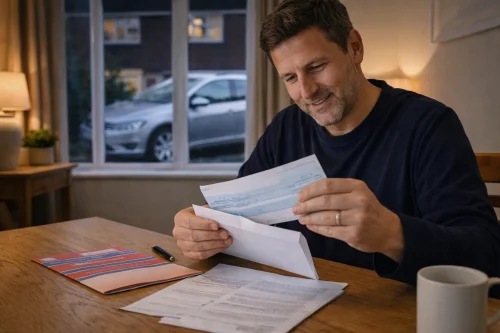
If a vehicle is sold or transferred, DVLA normally cancels the existing vehicle tax once the change is reported. Any refund for full remaining months usually goes to the name and address on the V5C log book.
This means a new keeper does not receive the previous keeper’s unused tax. The new keeper must tax the vehicle separately.
Refunds are normally calculated only for full remaining months. Extra card fees or surcharges may not be refunded.
Can Someone Else Drive a Vehicle in the Disabled Tax Class?
Yes, but only where the journey is for the disabled person’s benefit. For example, someone may drive the vehicle to take the disabled person to an appointment or to collect shopping or prescriptions for them.
A nominated driver should not use the vehicle for their own personal use if the journey does not benefit the disabled person. If the vehicle is now being used as a normal private vehicle, the tax class should be changed.
Can You Drive While DVLA Processes the Change?
If the vehicle has been taxed correctly and you have submitted the required documents, GOV.UK guidance says you can usually continue using the vehicle while an application is being processed.
However, if you have bought a vehicle and it has not yet been taxed correctly in your name, you should tax it before driving it. New keepers are responsible for making sure the vehicle is taxed before it is used on the road.
What Happens If You Do Not Change the Tax Class?
If the vehicle is no longer eligible for disabled tax and you continue using it without correcting the tax class, enforcement action may follow.
DVLA vehicle enforcement can involve checks against the vehicle register, reports of untaxed vehicles, Automatic Number Plate Recognition cameras, wheelclamping, penalties, or other enforcement action.
The registered keeper is responsible for making sure the vehicle is properly taxed or declared off the road with a SORN.
Common Mistakes to Avoid
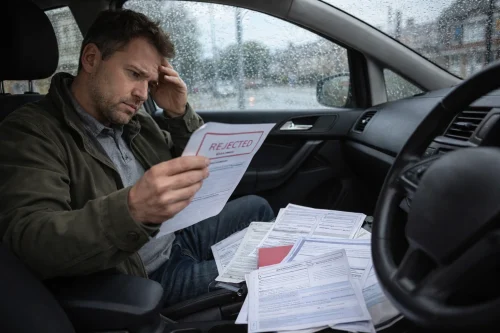
Avoid these mistakes when changing vehicle tax class from disabled to normal:
- Assuming disabled tax transfers with the car
- Driving before the vehicle is taxed in your name
- Going to a Post Office branch that does not handle vehicle tax
- Forgetting the V5C or green new keeper slip
- Not checking whether the vehicle needs a valid MOT
- Sending photocopies when original documents are required
- Using outdated vehicle tax rates
- Treating the disabled tax class as a permanent feature of the vehicle
- Forgetting Northern Ireland insurance and MOT document requirements
- Relying on unofficial forum advice instead of GOV.UK guidance
Quick Checklist Before You Go to the Post Office
Before visiting the Post Office, make sure you have:
- V5C log book or green new keeper slip
- V62 form if the V5C is missing
- MOT evidence if required
- V112 form if MOT exempt
- Payment method for the correct vehicle tax
Insurance certificate if the vehicle is registered in Northern Ireland
- The vehicle registration number
- Details of the current tax class
It is also worth checking the Post Office branch finder before travelling, because not every branch handles vehicle tax.
Conclusion
Changing vehicle tax class from disabled to normal is important when the vehicle is no longer eligible for disabled tax. In most cases, the change is completed at a Post Office branch that deals with vehicle tax.
The key point is that disabled tax does not automatically transfer to a new keeper. If you buy a used car that was previously taxed in the disabled class, you must tax it correctly before driving.
Take the V5C or green new keeper slip, MOT evidence if needed, and payment for the correct vehicle tax. Acting quickly helps you avoid penalties and keeps the vehicle properly taxed.
FAQs
How do I change vehicle tax class from disabled to normal?
You usually need to visit a Post Office branch that deals with vehicle tax. Take your V5C log book or green new keeper slip, MOT evidence if needed, and payment for the correct vehicle tax.
Can I change disabled car tax to normal online?
No, not usually. Changing a car tax class to or from disabled normally has to be done through a Post Office vehicle tax branch.
What happens if I buy a car with disabled tax?
The disabled tax does not transfer to you. You must tax the vehicle in your own name before driving it.
Do I need a V5C to change from disabled tax to normal tax?
You usually need the V5C. If you do not have it, you may need to complete form V62. If you recently bought the vehicle, the green new keeper slip may help.
How much does it cost to change from disabled tax to normal tax?
The cost depends on the vehicle’s tax rate. For many cars registered on or after 1 April 2017, the standard annual rate from April 2026 is £200, although some vehicles cost more or less depending on their tax rules.
Can someone else drive a disabled tax vehicle?
Yes, but only if the journey benefits the disabled person. The vehicle should not be used by a nominated driver for their own personal use.
Do I need insurance to change the tax class?
In Great Britain, you do not usually need to show insurance simply to change the tax class at the Post Office, but the vehicle must be insured if it is driven on the road. In Northern Ireland, insurance evidence may be required when taxing the vehicle.
Will the previous owner get a refund?
Yes, if there are full remaining months of vehicle tax, the refund usually goes to the name and address on the V5C log book.
Can I drive while the change is being processed?
You can usually use the vehicle while an application is being processed if it has been taxed correctly and the required documents have been submitted. A new keeper should tax the vehicle before driving it.
What if the vehicle is not being used?
If the vehicle is kept off public roads and not being driven, you may need to make a Statutory Off Road Notification instead of taxing it.
Sources
- GOV.UK – Change your vehicle’s tax class
- GOV.UK – Change tax class at a Post Office when tax is due to run out or exemption is changing
- GOV.UK – V70 application to change a vehicle’s tax class
- GOV.UK – Tax your vehicle and change tax class to or from disabled
- GOV.UK – Get free vehicle tax if you’re a driver with a disability
- GOV.UK – Financial help for disabled people: vehicles and transport
- GOV.UK – Vehicle tax rate tables
- GOV.UK – Tell DVLA you’ve sold, transferred or bought a vehicle
- GOV.UK – Cancel your vehicle tax and get a refund
- GOV.UK – Vehicle enforcement policy
- Post Office – Buy or renew your vehicle tax
- DVLA INS216 – How to apply for free disabled tax
- GOV.UK – Apply for a vehicle log book if you cannot apply online