




Table of Contents
Information checked against: GOV.UK and HMRC guidance
Important note: This guide is for general information only and should not be treated as personal tax advice. Pension, savings, property, overseas income and investment tax rules can depend on individual circumstances. If unsure, use HMRC’s official checker or speak to HMRC or a qualified tax adviser.
Many UK pensioners do not need to file a Self Assessment tax return simply because they receive a State Pension or private pension.
However, some pensioners do need to file, especially if they have untaxed income, rental income, foreign income, self-employment earnings, capital gains, or if HMRC sends a formal notice to file.
For the 2026/27 tax year, the standard Personal Allowance is £12,570. This means most people can receive up to £12,570 of taxable income before Income Tax is due.
However, needing to pay tax and needing to file a Self Assessment return are not always the same thing. In many pension cases, HMRC may collect tax through PAYE, adjust a tax code, or issue a Simple Assessment instead of asking for a full tax return.
Quick Answer: Do Pensioners Need to File a Tax Return?
| Pensioner situation | Is a tax return usually needed? |
| Only State Pension and income below the Personal Allowance | Usually no |
| State Pension plus private or workplace pension taxed through PAYE | Usually no, unless HMRC asks |
| HMRC sends a Simple Assessment letter | Usually no Self Assessment, but the bill must be checked and paid |
| HMRC sends a notice to file a tax return | Yes, unless HMRC withdraws the notice |
| Self-employment or freelance income over £1,000 before expenses | Usually yes |
| Rental income from property | Often yes, depending on amount and allowances |
| Foreign pension, overseas property income or other foreign income | Usually yes |
| Capital gains that need to be reported | Yes |
| Large savings, investment or dividend income | Sometimes, depending on amount and how HMRC can collect the tax |
What Determines If a Pensioner Must Submit a Self Assessment Tax Return?
A pensioner may need to submit a Self Assessment tax return if HMRC cannot collect the correct tax automatically or if the person has income that must be reported directly.
The main factors are:
- Type of income received
- Whether tax has already been deducted
- Whether total taxable income exceeds allowances
- Whether HMRC has issued a notice to file
- Whether the pensioner has untaxed or complex income
- Whether there are capital gains or overseas income to report
A key point is that the State Pension is taxable, but it is normally paid without tax being deducted first.
If the pensioner has another income source, such as a private pension or employment income, HMRC may collect tax due on the State Pension through the PAYE tax code used by the pension provider or employer.
When Pensioners Usually Do Not Need to File a Tax Return?
Many pensioners will not need to file a tax return where their tax affairs are straightforward.
You may not need to file if:
- Your only income is the State Pension and it is below the Personal Allowance.
- Your State Pension and private pension are taxed correctly through PAYE.
- HMRC collects any tax due by adjusting your tax code.
- HMRC sends you a Simple Assessment instead of a Self Assessment request.
- You have no untaxed income, no reportable capital gains and no foreign income.
- HMRC has not sent you a notice to file a return.
However, you should not assume that no return is needed simply because you are retired. If your circumstances change, such as receiving rental income, selling an asset at a gain, receiving overseas income or starting consultancy work, you may need to report this to HMRC.
When Pensioners Usually Do Need to File a Tax Return?
A pensioner is more likely to need a Self Assessment tax return if they have income that HMRC cannot fully tax through PAYE or Simple Assessment.
You may need to file if you:
- Are self-employed as a sole trader and earn more than £1,000 before expenses.
- Receive rental income from a property.
- Receive foreign income, including an overseas pension or foreign property income.
- Have income from savings, investments or dividends that must be reported.
- Need to pay Capital Gains Tax after selling or disposing of an asset.
- Are a partner in a business partnership.
- Need to claim certain tax reliefs that require Self Assessment.
- Have received a notice to file from HMRC.
If HMRC sends you a notice to file, you must complete the return by the deadline unless HMRC agrees to withdraw the notice. Even if you believe no tax is due, ignoring the notice can lead to penalties.
Is the State Pension Taxed Automatically?
The State Pension is taxable income, but tax is not deducted before it is paid. This can confuse many pensioners because the payment arrives gross, unlike many workplace or private pensions.
If the State Pension is your only income and it is below your Personal Allowance, you usually will not pay Income Tax.
If your State Pension plus other income takes you above the Personal Allowance, HMRC may collect the tax in one of three ways:
- Through PAYE on a private or workplace pension
Your pension provider may deduct tax before paying your pension. - Through an adjusted tax code
HMRC may adjust your tax code so tax owed on the State Pension is collected from another taxable income source. - Through Simple Assessment
If HMRC cannot collect the tax automatically through PAYE, it may send a Simple Assessment bill.
A Self Assessment return is not always needed just because your State Pension is taxable.
What Is Simple Assessment for Pensioners?
Simple Assessment is a process HMRC uses to calculate tax without requiring a full Self Assessment tax return.
This can apply to pensioners with relatively straightforward tax affairs, especially where HMRC already has enough information from:
- DWP about State Pension entitlement
- Pension providers
- Employers
- Banks and building societies
- Other data HMRC already receives
If you receive a Simple Assessment letter, also known as a PA302, it will show HMRC’s calculation and the amount of tax due or any refund due.
What Pensioners Should Do After Receiving a Simple Assessment Letter?
If you receive a Simple Assessment letter:
- Check your name, address and tax year.
- Check the income figures, including State Pension and private pension figures.
- Check whether savings interest or other income has been included correctly.
- Contact HMRC if the information is wrong or incomplete.
- Pay by the deadline shown on the letter if the calculation is correct.
HMRC says most Simple Assessment letters are sent between July and August after the end of the tax year, although they can be sent at other times. If the information is wrong or you have additional untaxed income, HMRC should be contacted within 60 days.
What Types of Pensioner Income May Need to Be Reported?
Pensioners may receive income from several sources. Some are taxed automatically, while others may need to be reported.
| Income type | How it is usually handled |
| State Pension | Taxable but paid without tax deducted |
| Workplace or private pension | Usually taxed through PAYE |
| Employment income after retirement | Usually taxed through PAYE |
| Self-employment or consulting income | May require Self Assessment if over the trading allowance |
| Rental income | Often reportable, depending on amount and allowances |
| Savings interest | May be taxed through tax code or reported, depending on amount |
| Dividends | May need to be reported if above allowances |
| Capital gains | May need to be reported and taxed |
| Foreign pension or overseas income | Usually needs to be reported |
| Taxable state benefits | Count as taxable income where applicable |
Do Pensioners Need to Report Savings Interest?
Savings interest can be taxable, but many pensioners can receive some savings interest tax-free.
The main savings allowances are:
- Personal Allowance: Can cover savings interest if not used by pension or other income.
- Starting rate for savings: Up to £5,000, depending on other income.
- Personal Savings Allowance: Up to £1,000 for basic-rate taxpayers, £500 for higher-rate taxpayers and £0 for additional-rate taxpayers.
If you receive savings interest above your allowance, HMRC may collect tax by changing your tax code if you are employed or receive a pension. If savings and investment income is high, Self Assessment may be required.
Do Pensioners Need to Report Dividends?
Dividend income has its own allowance. For 2026/27, the dividend allowance is £500.
You do not pay tax on dividends that fall within your Personal Allowance or dividend allowance. You also do not pay dividend tax on shares held inside an ISA.
If your dividend payments exceed both your unused Personal Allowance and the dividend allowance, you need to report them to HMRC. Depending on the amount and your tax situation, HMRC may collect the tax through your tax code or may require Self Assessment.
For 2026/27, dividend tax rates above the allowance are:
| Tax band | Dividend tax rate |
| Basic rate | 10.75% |
| Higher rate | 35.75% |
| Additional rate | 39.35% |
Do Pensioners Need to File for Rental Income?
Rental income is one of the most common reasons a pensioner may need to file a Self Assessment tax return.
You may need to report rental income if you receive money from:
- A buy-to-let property
- A second home
- A holiday let
- Renting out land
- Renting out part of your home
- Overseas property
There is a property allowance of up to £1,000 for some property income, but the rules depend on the type and amount of rental income.
If you have rental expenses, mortgage interest, joint ownership, furnished holiday letting issues or overseas property, the position can become more complex.
Pensioners with rental income should keep records of:
- Rent received
- Letting agent statements
- Mortgage interest statements
- Repair and maintenance costs
- Insurance
- Service charges
- Ground rent
- Council tax or utilities paid by the landlord
- Legal and accountancy costs
Do Pensioners Need to File for Capital Gains?
A pensioner may need to report and pay Capital Gains Tax if they sell or dispose of an asset that has increased in value.
This may include:
- A second home
- A buy-to-let property
- Shares outside an ISA
- Investment funds outside an ISA
- Valuable personal possessions
- Business assets
For the 2026/27 tax year, the Capital Gains Tax annual exempt amount for individuals is £3,000. If gains exceed the available allowance, or if the gain must be reported under HMRC rules, a tax return or separate Capital Gains Tax report may be needed.
Do Pensioners Need to File for Foreign Income?
Foreign income is another common reason a pensioner may need to file a tax return.
This can include:
- Overseas pensions
- Foreign rental income
- Interest from overseas bank accounts
- Dividends from overseas shares
- Income from foreign trusts
- Gains on overseas assets
UK tax residents are generally taxed on worldwide income unless specific rules, remittance basis rules or double tax treaty rules apply. This is an area where professional advice is often sensible, especially if tax has already been paid overseas.
What Are the Key Self Assessment Deadlines?

For the 2025/26 tax year, which ended on 5 April 2026, the main Self Assessment deadlines are:
| Action | Deadline |
| Register for Self Assessment if you need to file and have not filed before | 5 October 2026 |
| Submit paper tax return | 31 October 2026 |
| Submit online tax return | 31 January 2027 |
| Pay tax owed | 31 January 2027 |
| Second payment on account, if required | 31 July 2027 |
If you register late, HMRC may give a different filing deadline, but tax owed will still usually need to be paid by 31 January.
What Happens If a Pensioner Ignores a Self Assessment Notice?
Ignoring a Self Assessment notice can lead to penalties, even if the person believes they do not owe tax.
HMRC late filing penalties can include:
- An initial £100 penalty
- Daily penalties after 3 months
- Further penalties after 6 months
- Further penalties after 12 months
Late payment can also lead to penalties and interest. HMRC may also take debt recovery action where tax remains unpaid.
If you receive a notice to file and believe you should not be in Self Assessment, contact HMRC before the deadline and ask whether the notice can be withdrawn. Do not simply ignore the letter.
How Can Pensioners Check If They Need to File?
Pensioners can take the following steps:
1. Use HMRC’s official checker
GOV.UK provides an online tool to check whether a Self Assessment tax return is needed. This is the safest starting point because the tool asks about income sources and tax circumstances.
2. List all taxable income
Add up income from:
- State Pension
- Private pensions
- Workplace pensions
- Employment
- Self-employment
- Rental property
- Savings interest
- Dividends
- Capital gains
- Overseas income
- Taxable state benefits
3. Check whether tax has already been deducted
Private pensions and employment income are often taxed through PAYE. State Pension is not taxed at source.
4. Review your tax code
A tax code may include adjustments for State Pension or other income. If your tax code is wrong, you could overpay or underpay tax.
5. Check HMRC letters carefully
Letters such as a notice to file, tax calculation, P800 or PA302 Simple Assessment should not be ignored.
6. Ask HMRC or a tax adviser if unsure
Tax can be complex where there are multiple pensions, property income, foreign income, investments or large pension withdrawals.
How Can Pensioners File a Tax Return Efficiently?
If you need to file a Self Assessment tax return, preparation is the key.
Useful documents include:
- P60 from pension providers
- P45 if you stopped work
- State Pension amount for the tax year
- Bank and building society interest statements
- Dividend vouchers or investment platform statements
- Rental income and expense records
- Capital gains calculations
- Foreign income statements
- Details of pension lump sums
- Charity Gift Aid records
- Marriage Allowance or Married Couple’s Allowance information
- Previous HMRC letters and tax codes
Pensioners can file online through GOV.UK or send a paper return. Online filing usually gives more time, while paper filing has an earlier deadline.
How Can Pensioners Reduce Their Tax Bill Legally?
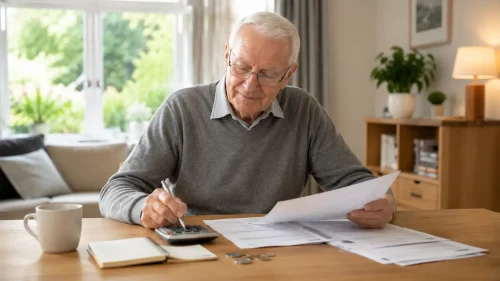
Pensioners may be able to reduce their tax bill by using available allowances and reliefs correctly.
Common examples include:
Marriage Allowance
If you are married or in a civil partnership, and one partner has income below the Personal Allowance while the other is a basic-rate taxpayer, Marriage Allowance may reduce the couple’s overall tax bill.
Married Couple’s Allowance
Some older couples may qualify for Married Couple’s Allowance if they are married or in a civil partnership and at least one partner was born before 6 April 1935.
Personal Savings Allowance
Basic-rate taxpayers may receive up to £1,000 of savings interest tax-free. Higher-rate taxpayers may receive up to £500. Additional-rate taxpayers do not receive this allowance.
ISA income
Interest and dividends from ISAs are not taxed, and ISA income does not count towards the Personal Savings Allowance or dividend allowance.
Pension tax-free lump sum
Many people can usually take up to 25% of a private pension pot as a tax-free lump sum, subject to the lump sum allowance and any protected allowance rules.
No National Insurance after State Pension age
Most people stop paying National Insurance after reaching State Pension age, although special rules apply to self-employed Class 4 contributions in the tax year after reaching State Pension age.
What If a Pensioner Has Paid Too Much Tax?
Pensioners can overpay tax for several reasons, including:
- Emergency tax on pension withdrawals
- Incorrect tax codes
- Multiple pension providers
- A private pension provider deducting too much tax
- Incorrect savings interest estimates
- HMRC using outdated income information
If you think you have overpaid tax:
- Check your Personal Tax Account.
- Review your tax code.
- Compare your P60 figures with actual income.
- Contact HMRC if the figures are wrong.
- Use the correct HMRC refund form for pension withdrawals.
Common pension refund forms include:
- P53 for certain small pension lump sums
- P53Z if you have flexibly accessed all of your pension
- P55 if you have flexibly accessed part of your pension and not emptied the pot
- P50Z if you have stopped work and flexibly accessed all of your pension
Practical Checklist for Pensioners
Before deciding whether a tax return is needed, ask:
- Did HMRC send me a notice to file?
- Is my State Pension my only income?
- Is my total taxable income above £12,570?
- Is my private pension taxed through PAYE?
- Do I receive rental income?
- Do I receive overseas income?
- Did I sell shares, property or another asset for a gain?
- Did I earn more than £1,000 from self-employment or consulting?
- Did I receive dividends above the dividend allowance?
- Did my savings interest exceed my allowances?
- Have I checked my tax code?
- Have I used HMRC’s official Self Assessment checker?
Conclusion
Pensioners in the UK do not automatically need to file a tax return. Many retired people have their tax handled through PAYE, tax code adjustments or Simple Assessment.
However, a Self Assessment tax return may be required if you have untaxed income, rental income, self-employment earnings, foreign income, capital gains, large savings or investment income, or if HMRC sends a notice to file.
The safest approach is to review all income sources each tax year, check HMRC letters carefully, use the official GOV.UK checker and keep accurate records.
If your income is straightforward, you may not need Self Assessment. If your income is complex, getting advice early can help avoid penalties and overpayments.
Frequently Asked Questions
Do pensioners need to file a tax return in the UK?
Not always. Many pensioners do not need to file if their income is taxed through PAYE or handled through Simple Assessment. A return may be needed if there is untaxed income, foreign income, rental income, self-employment income, capital gains or an HMRC notice to file.
Is the State Pension tax-free?
No. The State Pension is taxable income, but it is paid without tax being deducted. Tax is only due if total taxable income exceeds available allowances.
Do I need a tax return if my State Pension is my only income?
Usually not if your State Pension is below the Personal Allowance. If it exceeds the allowance and no tax can be collected through PAYE, HMRC may send a Simple Assessment bill instead.
What is the Personal Allowance for pensioners in 2026/27?
The standard Personal Allowance for 2026/27 is £12,570. Some people may have a different allowance because of income level, Blind Person’s Allowance, Marriage Allowance or other adjustments.
Do pensioners pay National Insurance?
Most people stop paying National Insurance after reaching State Pension age. Different timing rules can apply to self-employed Class 4 National Insurance.
Do pensioners need to report savings interest?
Sometimes. Savings interest may be covered by the Personal Allowance, starting rate for savings or Personal Savings Allowance. If interest exceeds available allowances, HMRC may collect tax through a tax code or may require reporting.
Do pensioners need to report dividends?
Dividend income above the unused Personal Allowance and dividend allowance must be reported to HMRC. Whether this means Self Assessment depends on the amount and the person’s tax circumstances.
Do pensioners need to file a tax return for rental income?
Often yes. Rental income is a common reason for filing Self Assessment, especially where income exceeds available allowances or expenses need to be claimed.
What happens if HMRC sends a notice to file?
You must file the return by the deadline unless HMRC withdraws the notice. Ignoring it can lead to penalties.
What is Simple Assessment?
Simple Assessment is where HMRC calculates tax using information it already holds and sends a bill, usually on a PA302 letter. It can help some pensioners avoid filing a full Self Assessment return.
What should I do if I think my tax code is wrong?
Check your Personal Tax Account or contact HMRC. An incorrect tax code can cause overpayment or underpayment, especially where State Pension and private pensions are involved.
Can pensioners claim back overpaid tax?
Yes. Pensioners may be able to claim a refund if too much tax was deducted, especially after flexible pension withdrawals or incorrect PAYE coding.
Sources
- GOV.UK – Income Tax rates and Personal Allowances
- GOV.UK – Self Assessment tax returns: who must send a tax return
- GOV.UK – Check if you need to send a Self Assessment tax return
- GOV.UK – Tax when you get a pension
- GOV.UK – Tax when you get a pension: how your tax is paid
- GOV.UK – Simple Assessment guide for pensioners
- GOV.UK – Pay your Simple Assessment tax bill
- GOV.UK – Self Assessment deadlines
- GOV.UK – Self Assessment penalties
- GOV.UK – Tax on savings interest
- GOV.UK – Tax on dividends
- GOV.UK – Capital Gains Tax rates and allowances
- GOV.UK – National Insurance and tax after State Pension age
- GOV.UK – Pension lump sum allowance
- GOV.UK – Claim back tax on a flexibly accessed pension overpayment P55