



Table of Contents
Yes, members of the public can legally own certain guns in the UK, but the rules depend on the firearm and where in the UK the person lives.
In Great Britain, many rifles and shotguns can be legally possessed with the appropriate police-issued certificate. Certain lower-powered air weapons may be possessed without a firearm certificate in England and Wales, while Scotland has a separate air weapon licensing system. Northern Ireland also operates under separate firearms legislation.
Most conventional short handguns, fully automatic firearms and several other categories of weapon are prohibited in Great Britain except in limited circumstances.
Firearms law is complex, so anyone considering acquiring or possessing a firearm should check the current Home Office firearms licensing guidance and advice from the relevant police licensing authority.
Last Updated: 01.09.2026
Legal Guns in the UK at a Glance
The following table provides a general overview. Individual firearms can fall into different legal categories depending on their specifications and intended use.
| Firearm Type | General Position in Great Britain | Main Requirement |
| Bolt-Action Rifles | Generally Permitted | Firearm Certificate |
| Certain .22 Rim-Fire Self-Loading Rifles | Generally Permitted | Firearm Certificate |
| Section 2 Shotguns | Generally Permitted | Shotgun Certificate |
| Section 1 Shotguns | Potentially Permitted | Firearm Certificate |
| Muzzle-Loading Pistols | Potentially Permitted | Usually Firearm Certificate |
| Certain Long-Barrelled Pistols and Revolvers | Potentially Permitted | Firearm Certificate |
| Lower-Powered Air Rifles in England and Wales | Generally No Firearm Certificate Required | Other Legal Restrictions Apply |
| Most Conventional Short Handguns in Great Britain | Generally Prohibited | Limited Exceptions |
| Fully Automatic Firearms | Prohibited | Special Authority Required |
The exact legal classification is important because two firearms that appear similar can be treated differently under firearms legislation.
Guns That Are Legal in the UK
1. Rifles
A person can legally possess certain rifles in Great Britain when they have an appropriate Firearm Certificate.
This can include bolt-action and other manually operated rifles used for activities such as target shooting, pest control, game management and other legitimate purposes.
Certain self-loading or pump-action rifles are prohibited. However, the law contains an exception for some firearms chambered for .22 rim-fire cartridges.
Applicants for a Firearm Certificate generally need to demonstrate a legitimate reason for possessing each firearm.
The Home Office recognises purposes such as sport, work, recreation, collecting and research, depending on the circumstances.
For target shooting, membership of an approved shooting club can be an important part of demonstrating a legitimate reason for possessing a rifle.
2. Shotguns
Shotguns are another category of firearm that members of the public may legally possess.
A shotgun falling within the standard Section 2 definition generally requires a Shotgun Certificate rather than a Firearm Certificate.
Under the Firearms Act 1968 definition, a Section 2 shotgun is generally a smooth-bore gun with a barrel of at least 24 inches and either no magazine or a non-detachable magazine that cannot hold more than two cartridges.
This means the old claim that every legal shotgun can hold no more than three shells is misleading. The law specifically considers magazine capacity, firearm design and classification.
Some shotguns that fall outside the Section 2 definition may instead be controlled under Section 1 and require a Firearm Certificate.
Single-barrelled and double-barrelled shotguns are commonly encountered legal configurations. Certain pump-action and self-loading shotguns can also be lawful provided they meet the relevant legal requirements.
3. Air Rifles and Air Pistols
Air weapon rules vary significantly across the UK.
In England and Wales, lower-powered air weapons are generally exempt from the normal firearm certification process.
An air rifle capable of exceeding 12 foot-pounds of muzzle energy is regarded as specially dangerous and normally requires a Firearm Certificate. An air pistol exceeding 6 foot-pounds falls into a more restricted category and can be prohibited.
Even where an air weapon does not require a Firearm Certificate, other rules still apply to its purchase, possession, storage, use and access by young people.
Scotland operates differently. Air weapons covered by the Air Weapons and Licensing (Scotland) Act 2015 generally require an Air Weapon Certificate unless an exemption applies.
Northern Ireland has another system. Airguns and CO2 guns producing more than one joule of muzzle energy generally need to be held on a firearm certificate there.
4. Muzzle-Loading Pistols
Muzzle-loading pistols are an important exception to the widespread prohibition affecting conventional short handguns in Great Britain.
The general prohibition affecting firearms with a barrel shorter than 30cm or an overall length below 60cm specifically excludes muzzle-loading guns.
However, this does not mean that muzzle-loading pistols are unrestricted.
Modern muzzle-loading pistols and revolvers will commonly be subject to Firearm Certificate requirements. Someone whose sole reason for possessing a muzzle-loading pistol is target shooting will generally need to meet the relevant approved-club requirements.
5. Long-Barrelled Pistols and Revolvers
Certain long-barrelled pistols and revolvers can also legally be possessed in Great Britain on a Firearm Certificate.
The legislation generally prohibits small firearms where the barrel is less than 30cm or the firearm is less than 60cm in overall length, subject to statutory exceptions.
A pistol or revolver that falls outside those prohibited dimensions may therefore be treated as a Section 1 firearm rather than a prohibited short firearm.
This is why saying that “all handguns are illegal in the UK” is too broad. Most conventional short cartridge-firing handguns are prohibited in Great Britain, but there are specific exceptions and differently classified firearms.
What Guns Are Prohibited in the UK?
The main framework controlling firearms in Great Britain is the Firearms Act 1968, which has been amended many times since it was originally passed.
Possessing a prohibited weapon normally requires specific statutory authority or an applicable exemption.
1. Fully Automatic Firearms
Fully automatic firearms are generally prohibited.
This includes firearms capable of repeatedly discharging missiles while the trigger remains activated, along with burst-fire weapons capable of firing several rounds from a single trigger operation.
These weapons generally cannot simply be acquired through an ordinary Firearm Certificate.
2. Most Conventional Handguns in Great Britain
Most conventional short-cartridge-firing handguns are prohibited in Great Britain.
Rather than simply prohibiting something described as a “handgun”, the legislation primarily restricts small firearms according to characteristics such as barrel and overall length.
There are limited exemptions, including rules relating to certain historic firearms, muzzle-loading firearms and firearms possessed under specific statutory authority.
Northern Ireland is different and operates its own firearms licensing framework.
3. Disguised Firearms
Firearms disguised as other objects are prohibited weapons.
The law is particularly restrictive towards firearms designed or adapted so that they do not immediately appear to be firearms.
Such weapons should not be confused with ordinary sporting or recreational firearms held under the appropriate certificate.
4. Weapons Designed to Discharge Noxious Substances
Weapons designed or adapted to discharge harmful liquids, gases or other noxious substances can fall within the prohibited-weapons provisions.
This category should not simply be described as “air guns that give out harmful gases”, as air weapons and weapons designed to discharge noxious substances are legally different categories.
5. Certain Short Firearms and Restricted Weapons
A firearm can also become prohibited because of its dimensions, firing mechanism or design.
For example, firearms with a barrel under 30cm or an overall length below 60cm are generally prohibited small firearms in Great Britain unless a statutory exception applies, such as the exception covering muzzle-loading firearms.
Certain short pump-action or self-loading smooth-bore firearms, rocket launchers and mortars also fall within prohibited categories.
UK vs Great Britain: Why Location Matters
One of the most important things to understand about UK gun law is that the rules are not identical everywhere.
England and Wales
The Firearms Act 1968 provides the main framework governing firearms possession in England and Wales.
Firearm Certificates and Shotgun Certificates are issued by the police, while many lower-powered air weapons are outside the standard certificate system.
However, restrictions still apply to air weapon possession, sales, storage and use.
Scotland
Most conventional firearm and shotgun licensing rules in Scotland also operate under the wider Great Britain firearms framework.
Air weapons are an important exception.
Scotland has its own Air Weapon Certificate system. Subject to exemptions, people who want to possess, use, purchase or acquire regulated air weapons generally require an Air Weapon Certificate.
Northern Ireland
Northern Ireland has its own firearms legislation and licensing arrangements administered by the Police Service of Northern Ireland.
The rules can therefore differ from those applying in England, Wales and Scotland.
One notable example is air weapons. In Northern Ireland, airguns and CO2 guns producing more than one joule generally require a firearm certificate.
For this reason, anyone searching for information about “UK gun laws” should check which UK nation the guidance applies to.
What Changed in UK Firearms Law in 2025 and 2026?
UK firearms licensing has seen several recent changes that firearm and shotgun certificate holders should be aware of.
Two-Referee Requirement
From 5 August 2025, applicants for both firearm and shotgun certificates in Great Britain are required to provide two referees.
Previously, shotgun applications generally required only one referee.
The referees must meet eligibility requirements, including having known the applicant personally for at least two years and not being an immediate family member.
Updated Firearm and Shotgun Certificate Fees
Firearms licensing fees increased from 4 June 2026.
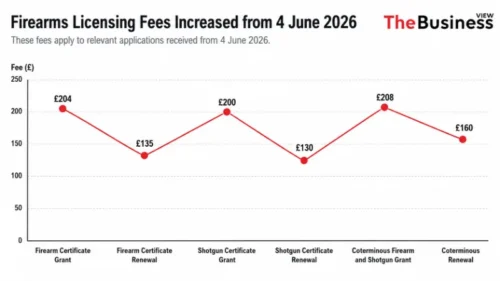
The updated fees include:
- Firearm Certificate Grant: £204
- Firearm Certificate Renewal: £135
- Shotgun Certificate Grant: £200
- Shotgun Certificate Renewal: £130
- Coterminous Firearm and Shotgun Grant: £208
- Coterminous Renewal: £160
These fees apply to relevant applications received from 4 June 2026.
Changes to Sound Moderator Rules
Another significant change took effect on 29 June 2026.
Sound moderators and certain related accessories were removed from the statutory definition of a firearm following changes made by the Crime and Policing Act 2026.
However, this does not mean anyone can possess them without restriction. The revised legislation introduced requirements relating to possession by holders of firearm or shotgun certificates and applicable exemptions.
Latest Home Office Firearms Licensing Guidance
The Home Office updated its consolidated firearms licensing guidance on 3 August 2026, including further information following the changes affecting sound moderators.
Anyone relying on older articles about UK firearms law should therefore check whether the information reflects these recent changes.
Firearm Certificate vs Shotgun Certificate
A Firearm Certificate and Shotgun Certificate are not interchangeable.
| Requirement | Firearm Certificate | Shotgun Certificate |
| Commonly Known As | FAC | SGC |
| Covers | Section 1 Firearms and Relevant Ammunition | Section 2 Shotguns |
| Good Reason | Must Be Demonstrated for Firearms Requested | Different Statutory Test Applies |
| Police Suitability Assessment | Yes | Yes |
| Medical Information | Yes | Yes |
| Referees | Two | Two |
| Security Assessment | Yes | Yes |
| Normal Validity | Five Years | Five Years |
A Firearm Certificate lists the firearms and ammunition the holder is authorised to possess. Applicants must normally demonstrate a legitimate reason for the particular firearms requested.
Shotgun certificates operate under a different statutory test.
Applicants do not have exactly the same burden of demonstrating “good reason” as Firearm Certificate applicants, although the police can refuse an application in circumstances permitted by law.
Both certificates are normally valid for five years.
A broader House of Commons Library overview of UK firearms licensing also highlights the distinction between firearm and shotgun licensing and the complexity of the current legal framework.
Who Can Legally Own a Firearm in the UK?
Owning a firearm in the UK is subject to police licensing and public-safety requirements.
Obtaining a certificate involves considerably more than simply paying an application fee.
Good Reason for Ownership
Applicants for a Firearm Certificate must generally demonstrate a legitimate reason for possessing the particular firearm.
Common reasons can include:
- Target Shooting
- Pest Control
- Game Shooting
- Professional Use
- Collecting
- Research
- Certain Other Legitimate Sporting or Recreational Uses
A simple desire to own a gun is not, by itself, considered sufficient good reason for a Section 1 firearm.
Police Suitability Checks
Police assess whether an applicant can safely possess firearms without creating a danger to public safety or the peace.
The assessment can consider information relating to the applicant’s background, behaviour, domestic circumstances and other relevant factors.
Two Referees
Applicants for firearm and shotgun certificates must provide two suitable referees.
Referees generally need to:
- Live in Great Britain
- Have Known the Applicant for at Least Two Years
- Be of Good Character
- Not Be a Member of the Applicant’s Family
- Not Fall Within Certain Excluded Professional Categories
For first-time applications, police must contact both referees before granting the certificate.
Medical Information
Applicants must also provide relevant medical information.
The police consider medical information supplied by a GP or another suitably qualified GMC-registered doctor when determining suitability for both firearm and shotgun certificates.
The final decision on whether to issue the certificate remains with the police.
Home Visit and Interview
First-time applicants must receive a home visit before a certificate is granted.
The visit includes an interview and an inspection of the proposed security arrangements for the firearms or shotguns.
Police guidance also provides for relevant discussions with partners or other household members as part of the suitability assessment.
Secure Firearm Storage
Firearms and shotguns held on certificate must be stored securely so that unauthorised people cannot gain access to them.
Security arrangements are examined during the first-time home visit, and a certificate should not be granted where police have concerns about whether the proposed security measures are adequate.
The precise security arrangements required can depend on the firearm, property and individual circumstances.
How Must Firearms Be Stored?
Firearm security is an important condition of lawful possession.
Certificate holders are expected to prevent unauthorised access to their firearms and shotguns.
Police consider security arrangements when assessing an application and may inspect them again when circumstances require it.
Good firearm security is particularly important where children, visitors or other people who are not authorised to access the firearms live in or visit the property.
The appropriate arrangements depend on the circumstances, so certificate holders should follow the conditions of their certificate and advice from their local firearms licensing department.
Why Are UK Firearms Laws So Strict?
Britain’s restrictive approach to firearms did not begin with one single incident.
The Firearms Act 1968 consolidated much of the existing firearms legislation and remains a major part of the legal framework today, although it has subsequently been amended many times.
Further restrictions followed a number of serious incidents.
The Dunblane Massacre and Later Law Changes
On 13 March 1996, a gunman entered Dunblane Primary School in Scotland and killed 16 children and their teacher before killing himself.
The Dunblane massacre led to intense public and political debate about civilian handgun possession.
The Firearms (Amendment) Act 1997 and subsequent legislation introduced much tighter controls on short firearms in Great Britain.
However, it would be inaccurate to say that UK gun control began after Dunblane. Britain already had substantial firearms legislation before 1996, including the Firearms Act 1968.
Today, firearms regulation continues to develop through legislation, Home Office guidance, police licensing procedures and public-safety assessments.
Conclusion
Certain guns are legal to own in the UK, but there is no simple rule that applies to every firearm or every part of the country.
In Great Britain, members of the public can legally possess many rifles, shotguns, muzzle-loading firearms and certain long-barrelled pistols when the appropriate certificate and legal requirements are satisfied.
Lower-powered air weapons are generally treated differently in England and Wales, while Scotland operates an Air Weapon Certificate system.
Northern Ireland has its own firearms legislation and licensing arrangements.
At the same time, most conventional short handguns, fully automatic firearms and several other restricted categories are generally prohibited in Great Britain without specific authority or an exemption.
Because firearms legislation changes and the classification of an individual firearm can depend on its characteristics, people should always verify the current law and speak to the relevant police firearms licensing authority before acquiring or possessing a firearm.
This article provides general information about UK firearms law and should not be treated as individual legal advice.
FAQs
Can You Legally Own a Gun in the UK?
Yes. Certain rifles, shotguns and other firearms can legally be owned when the appropriate certificate and other legal requirements are satisfied.
What Rifles Are Legal in the UK?
Many manually operated rifles can be held on a Firearm Certificate. Certain .22 rim-fire self-loading rifles can also be permitted, while many other self-loading or pump-action rifles are prohibited.
Are Shotguns Legal in the UK?
Yes. Shotguns meeting the Section 2 definition can generally be possessed with a Shotgun Certificate, while some other shotguns require a Firearm Certificate.
Are Handguns Legal in the UK?
Most conventional short handguns are prohibited in Great Britain, but exceptions exist for categories such as certain muzzle-loading, historic and long-barrelled firearms. Northern Ireland has different rules.
Do You Need a Licence for an Air Rifle in the UK?
It depends on where you live and the air weapon’s classification. Lower-powered air rifles generally do not require a Firearm Certificate in England and Wales, while Scotland and Northern Ireland have different licensing rules.
What Is the Difference Between a Firearm Certificate and a Shotgun Certificate?
A Firearm Certificate generally covers Section 1 firearms and specified ammunition, while a Shotgun Certificate covers shotguns that fall within the Section 2 definition.
Are Gun Laws the Same in England, Scotland and Northern Ireland?
No. England and Wales and much of Scotland share the Great Britain firearms framework, but Scotland has separate air weapon licensing. Northern Ireland operates under separate firearms legislation.
