





Table of Contents
Amber reflective studs are found along the right-hand edge of a motorway or dual carriageway, between the running carriageway and the central reservation. They show drivers where the main carriageway ends on the central-reservation side of the road.
The official Highway Code Rule 132 confirms that amber studs mark the central reservation of a dual carriageway or motorway. White studs divide lanes, red studs identify the left edge, green studs mark slip roads and lay-bys, and green/yellow studs show temporary changes to lane layouts.
Reflective road studs are particularly useful at night, on wet roads and in poor visibility. They reflect vehicle headlights towards the driver, helping to make lane boundaries and carriageway edges easier to identify.
Amber Motorway Studs: Quick Answer
| Question | Answer |
| Where are amber studs found? | Along the right-hand edge of the carriageway next to the central reservation |
| What do they identify? | The boundary between the running carriageway and the central reservation |
| Are they used on dual carriageways? | Yes, they can be used on motorways and dual carriageways |
| Which side of the driver are they normally on? | The right-hand or offside edge |
| Do they separate ordinary traffic lanes? | No. White studs normally separate lanes travelling in the same direction |
| What colour marks the left edge? | Red |
| What colour marks slip roads? | Green |
| What colour is used for temporary lane layouts? | Green/yellow |
What Are Amber Reflective Road Studs?

Amber reflective studs are small road-safety devices positioned beside road markings. Their reflectors return light from vehicle headlights towards the approaching driver, making the road layout more visible in darkness, rain and fog.
They are sometimes broadly called cat’s eyes, although this term is also associated with the traditional depressible, self-cleaning road stud. Modern road studs can use several different designs, including depressible and non-depressible products, plastic reflectors and active studs incorporating their own light source.
The Department for Transport’s Traffic Signs Manual, Chapter 5 explains that retroreflective studs supplement longitudinal road markings and are especially valuable on wet roads at night or in fog, when painted markings can be more difficult to see.
Where Exactly Are Amber Reflective Studs Found on a Motorway?
On a typical UK motorway, amber studs run along the right-hand edge of each carriageway, directly beside the central reservation.
The layout can be understood as follows:
Central reservation → amber studs → right-hand lane → white lane studs → other lanes → red studs → hard shoulder or left edge
The studs do not sit between ordinary motorway lanes. Those lanes are normally separated by white road markings and white reflective studs.
Amber studs identify the offside boundary of the usable carriageway. The central reservation beyond that boundary separates the two carriageways carrying traffic in opposite directions.
Official technical guidance describes amber studs as indicating the right-hand edge of the running carriageway adjacent to the central reservation. They may also be used beside traffic cones or cylinders during certain roadworks and on the offside edge of a one-way road.
What Do the Different Motorway Stud Colours Mean?
The colours are not decorative. Each one communicates a particular part of the road layout.
| Stud colour | Where it is normally found | Meaning for drivers |
| White | Between motorway lanes or along the centre of a road | Separates traffic lanes or marks the centre of the carriageway |
| Red | Along the left-hand edge of the carriageway | Identifies the boundary beside the hard shoulder, hard strip or verge |
| Amber | Along the right-hand edge next to the central reservation | Identifies the offside boundary of the running carriageway |
| Green | At slip roads and lay-bys | Shows where traffic can enter, leave or cross the edge marking |
| Green/yellow | Through roadworks or altered lane layouts | Identifies temporary changes to the normal lane arrangement |
The government’s Know Your Traffic Signs guidance gives the same colour meanings and explains that coloured studs are intended to help drivers at night, on wet roads and in poor visibility.
Drivers learning motorway layouts may also find it useful to understand where crawler lanes are found and how signs and markings guide slower vehicles on steep sections.
Why Are Amber Studs Placed Beside the Central Reservation?
The central-reservation side of a motorway can become difficult to distinguish when visibility is reduced. An amber line of reflected light gives drivers a continuous reference point along the offside edge of the carriageway.
Amber studs help drivers:
- Recognise the right-hand limit of the carriageway
- Maintain an appropriate position in the outside lane
- Distinguish the central-reservation edge from ordinary lane divisions
- Follow the road through darkness, rain or fog
- Avoid drifting towards a barrier, verge or reserved area
- Understand temporary boundaries around some roadworks
They should be treated as an additional visual guide rather than a substitute for signs, lane markings, safe speed and proper observation.
Are Amber Studs on the Left or Right of a Motorway?
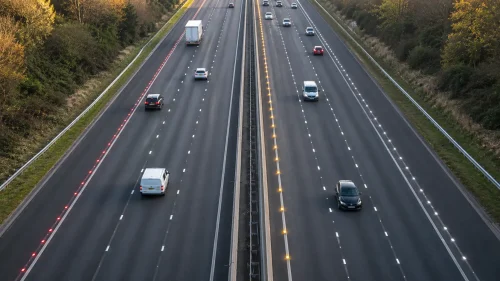
Amber studs are normally on the right-hand side of a UK motorway carriageway.
Red studs are normally on the left-hand side, beside the hard shoulder, hard strip or verge. White studs appear between traffic lanes, while green studs are associated with slip roads and lay-bys.
A simple way to remember the layout is:
- Red on the left
- Amber on the right
- White between lanes
- Green at slip roads
The driver’s direction of travel determines left and right. Both carriageways therefore have amber studs along their own right-hand edge beside the central reservation.
Do Amber Studs Mark the Fast Lane?
Amber studs do not mark a separate “fast lane”. They identify the edge of the carriageway beside the central reservation.
The lane closest to the amber studs is the right-hand lane, which should normally be used for overtaking. Drivers should return to a lane further left when it is safe after overtaking.
The Highway Code advises drivers on multi-lane dual carriageways to use the middle or right-hand lanes for overtaking and then return towards the left when safe. Learning the stud colours does not change the normal rules on lane discipline.
Are Amber Road Studs the Same as Cat’s Eyes?
“Cat’s eyes” is widely used as a general name for reflective road studs, but not every modern road stud uses the original Catseye design.
Traditional depressible studs sit inside a road-mounted housing. When a vehicle passes over the stud, it can be pushed down and wiped by a rubber component, helping to clean the reflectors.
Other road studs are non-depressible and may be bonded directly to the surface or installed in a fixed base. Some newer active studs produce light rather than relying solely on reflected headlights.
The shared purpose is to improve delineation: making the position, direction and boundaries of the carriageway easier to understand.
How Do Amber Studs Work at Night?
Most amber motorway studs use retroreflection. Instead of scattering headlight illumination in every direction, the reflector directs a significant portion of the light back towards its source.
Because the driver sits close to the vehicle’s headlights, the reflected light appears bright from the driver’s position. This allows the amber boundary to remain noticeable without requiring each stud to be electrically powered.
Their effectiveness depends on several factors, including:
- The condition and alignment of the reflector
- The cleanliness of the stud
- Headlight performance
- Vehicle position and approach angle
- Rain, standing water, dirt, snow or road debris
- Whether the stud has been damaged or displaced
Motorists should therefore never depend entirely on reflective studs when visibility is poor.
Can Amber Studs Still Be Seen in Rain, Fog or Snow?

Reflective road studs are intended to remain useful in wet weather and fog, particularly when painted road markings are harder to distinguish. The Traffic Signs Manual specifically recognises their value on wet roads at night and in areas prone to fog.
However, it would be inaccurate to claim that amber studs remain perfectly visible in every weather condition. Heavy snow, standing water, mud, road debris or damage can reduce or completely obscure their reflection.
During poor visibility, drivers should reduce speed, increase the distance from the vehicle ahead and follow all signs and signals. Studs provide guidance, but they do not guarantee that the road ahead is unobstructed.
What Happens to Amber Studs at Motorway Roadworks?
Temporary traffic management can alter the normal motorway layout. Drivers may encounter cones, temporary lane lines and road studs showing that lanes have narrowed, moved or entered a contraflow arrangement.
Green/yellow studs generally indicate temporary adjustments to lane layouts. Amber studs may also be installed beside traffic cones or cylinders to identify a boundary that should not be crossed.
Drivers should follow the temporary arrangement rather than relying on their memory of the permanent road. Signs, cones, temporary markings and instructions from authorised personnel take priority in determining the safe route.
The distinction is important:
- Amber normally identifies an offside boundary that should not be crossed
- Green/yellow identifies a temporary lane arrangement
- Green marks an edge that may be crossed at a slip road or lay-by
Drivers planning a journey affected by works can also check relevant route information, such as current M11 motorway closures and diversions, before travelling.
Can Drivers Cross Amber Reflective Studs?
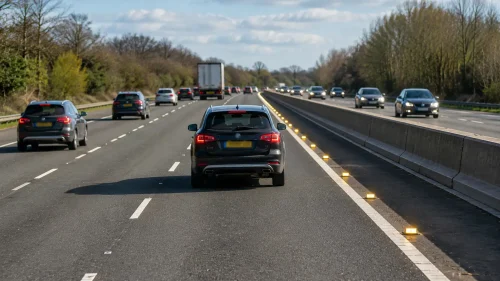
Drivers should not normally cross the amber-stud boundary because it marks the edge of the running carriageway beside the central reservation or another restricted boundary.
Normal lane changes take place across white lane markings, not across the amber line at the edge of the carriageway.
However, the stud colour alone does not create a separate automatic fixed penalty. Whether an offence has occurred depends on the accompanying road markings, signs, lane restrictions and the driver’s conduct.
Entering a central reservation, crossing into a closed roadworks area or ignoring mandatory signs can be dangerous and may breach other road traffic rules. Drivers should always obey the complete road layout rather than treating the studs as the only instruction.
For related guidance, see how to identify UK traffic signs that give orders.
Who Installs and Maintains Motorway Studs?
Responsibility depends on which part of the UK contains the motorway.
In England, National Highways operates, maintains and improves the strategic road network, which includes motorways and major A-roads.
In Scotland, trunk-road and motorway maintenance is managed through Transport Scotland and its operating companies. In Wales, the Welsh Government is responsible for motorways and trunk roads, with Trunk Road Agents carrying out day-to-day work. Northern Ireland’s public road network is managed by DfI Roads.
Road studs require regular inspection because traffic, resurfacing, weather and contamination can reduce their performance. Department for Transport guidance states that road markings and reflective studs should be inspected regularly, including checks of their night-time reflectivity where appropriate. It does not prescribe one universal replacement interval because deterioration depends on the product, road and traffic flow.
Are Amber Studs Used Consistently Across the UK?
The same core colour meaning is used throughout the UK: amber studs identify the central-reservation side of a motorway or dual carriageway.
The Highway Code for Great Britain and official Northern Ireland driver guidance both describe amber studs as marking the central reservation. This consistency helps motorists recognise the road layout when travelling between different parts of the UK.
Local engineering arrangements can still vary around junctions, roadworks, one-way slip roads and complex interchanges. Drivers must therefore consider the full combination of studs, lines, signs, cones and signals.
Are Amber and Yellow Motorway Studs the Same?
The official road-stud colour is amber, although it may look yellow, gold or orange when illuminated by headlights.
Amber studs should not be confused with green/yellow temporary studs used to indicate changes to a lane layout. Lighting, rain and viewing angle can alter how a colour appears, so drivers should also consider where the studs are positioned.
A continuous line beside the central reservation is normally amber. Studs directing traffic through a temporary roadworks layout may be green/yellow.
How Should Learner Drivers Remember Motorway Stud Colours?
Learner drivers can remember the system by connecting each colour with its position:
Red – left edge
Amber – central reservation
White – lanes
Green – gateways to slip roads
Green/yellow – temporary changes
The most important theory-test answer is straightforward:
Amber reflective studs are found between the right-hand edge of the carriageway and the central reservation on a motorway or dual carriageway.
What Should Drivers Do If Road Studs Are Missing or Damaged?
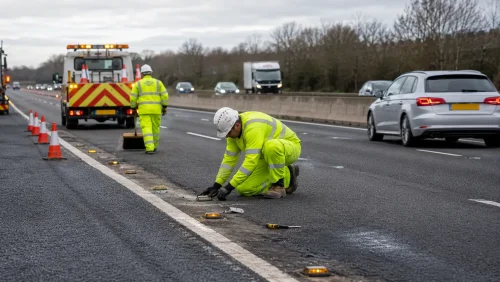
A missing or damaged stud can make a section of motorway harder to follow, particularly at night. Drivers should not stop on the motorway to examine or report it.
Where safe, the location can be noted and reported after the journey. In England, problems on motorways and major roads managed by National Highways can be reported through its contact channels. Scotland, Wales and Northern Ireland have their own road-management authorities.
If the defect creates an immediate danger, such as loose equipment obstructing a live lane, the priority is to move to a safe place and contact the appropriate emergency or highway authority.
Conclusion
Amber reflective studs are found along the right-hand edge of a UK motorway or dual carriageway, next to the central reservation. They identify the offside boundary of the running carriageway and help drivers understand the road layout at night and in poor visibility.
They are one part of a wider colour-coded system:
- White separates lanes
- Red marks the left edge
- Amber marks the central-reservation edge
- Green marks slip roads and lay-bys
- Green/yellow marks temporary lane changes
Drivers should use these studs alongside road signs, painted markings, signals and safe observation. Recognising the colours can make motorway journeys easier to interpret, but the live road layout and official instructions must always take priority.
Frequently Asked Questions
Where are amber reflective studs found on a motorway?
Amber reflective studs are found along the right-hand edge of the carriageway, between the running lanes and the central reservation.
What colour studs are between the motorway and central reservation?
Amber studs mark the edge of the central reservation on a motorway or dual carriageway.
Which motorway studs mark the hard shoulder?
Red reflective studs normally mark the left-hand edge of the carriageway beside the hard shoulder, hard strip or verge.
What colour studs separate motorway lanes?
White reflective studs normally separate traffic lanes moving in the same direction.
Where are green studs found on a motorway?
Green studs mark the edge of the main carriageway at slip roads and lay-bys, including places where traffic enters or leaves.
What do green and yellow motorway studs mean?
Green/yellow studs indicate temporary changes to the lane layout, usually around roadworks.
Do amber studs give off their own light?
Most conventional amber studs reflect vehicle headlights rather than producing their own light. Some modern active road studs can incorporate a light source.
Are amber studs used beside roadworks?
They can be used beside traffic cones or cylinders to mark a boundary. Green/yellow studs are used to identify temporary changes to the normal lane layout.
How far apart are motorway studs?
Spacing can vary according to the road design and markings. Department for Transport guidance says red, white and amber studs on dual carriageways are normally spaced at approximately 18-metre intervals, although different arrangements may be used where necessary.
Can motorists receive penalty points for crossing amber studs?
There is no separate automatic penalty based solely on touching an amber stud. Penalties may arise when a driver ignores associated signs or markings, enters a prohibited area, or drives carelessly or dangerously.